
Second hand bikes online are safe when you do three things before any money moves: look the number plate up on the government’s Vahan or mParivahan service, meet the person named on that RC with the bike, and pay only then, by a route that leaves a record. Every fraud we found skipped one of the three.
Listen to this article, about 19 minutes. A synthetic voice reads the article and announces each section title as it begins; tables are read row by row and the questions at the end are left out.
Recorded 13 November 2026 from the article as published that day. Press a chapter to jump there; the highlighted line is what is playing. A play button sits beside every section heading, and once you scroll past this player a bar at the bottom of the screen keeps the controls in reach. Tap or click any sentence to hear the reading start from there.
On this page: the Mumbai Police leaflet’s own description of the Army canteen card fraud, the field list of the government’s mParivahan RC search as published on 30 September 2026, a table of what to check before you travel, what four online buyers and sellers and one Pune police case reported between February and September 2026, and the 1930 figures the Home Ministry gave Parliament in July 2026.
Think you already know this? Five questions, one minute.
Every answer is on this page. Answer from what you know now; the page fills in the rest.
-
1. In the Mumbai Police leaflet’s account of the Army canteen fraud, what does the delivery boy ask the buyer to pay before the bike arrives?
The Mumbai Police cyber awareness leaflet says the delivery boy asks for money as a registration fee, GST and reverse GST, and that the seller then threatens the buyer with Army law when asked for a refund. Read the section
-
2. Which of these does the NIC’s mParivahan listing say the RC search returns?
The mParivahan listing, updated 30 September 2026, lists owner name, registration date, registering authority, make and model, fuel type, age, class, insurance validity and fitness validity; no contact details. Read the section
-
3. Under Section 50 of the Motor Vehicles Act, how long does a buyer have to apply for the RC transfer when the bike stays in the same state?
Section 50 of the Motor Vehicles Act, 1988 gives the seller fourteen days to report the sale and the buyer thirty days to apply for the transfer. Read the section
-
4. What was the only proof of purchase the February 2026 r/IndianBikes buyer had, five months after paying for a bike found on OLX?
The buyer wrote on the February 2026 thread that the previous owner had stopped replying and the chats were all he had; the page’s point is that the forms should be signed on the day of payment. Read the section
-
5. According to the Home Ministry’s release of 28 July 2026, how much money had the 1930 reporting system saved by 30 June 2026?
The PIB release of 28 July 2026 says more than Rs 11,158 crore had been saved in more than 32.80 lakh complaints through the Citizen Financial Cyber Fraud Reporting and Management System by 30 June 2026. Read the section
The internet makes it easy to see a thousand used motorcycles and scooters from your sofa, and about as easy to send Rs 5,000 to a stranger in another state. This page is about the gap between those two things: the Mumbai Police’s own description of the commonest fraud, the government lookups that defeat it, what online buyers and sellers reported between February and September 2026, and the first hour after a payment that should not have happened. Bike, here as everywhere on this site, means a motorcycle or a scooter. On 30 October 2026 we added how to get a bike bought in another city home, from the railway’s own parcel rules.
What do the frauds on online bike listings look like?
Like a very good price and a seller who cannot meet you. The Mumbai Police cyber awareness leaflet describes the version that has run for years: on OLX a person appears to be in the Army, offers a cheaper price because he is getting the goods from the Army canteen, and earns your trust by sending a fake canteen card and an Aadhaar card on WhatsApp. The leaflet says he intends to sell motorcycles, KTM bikes, four wheelers or electronic gadgets, asks for your Aadhaar and address to send the article, and then a delivery boy calls for money as a registration fee, GST and reverse GST. Ask for it back and, the leaflet says, he threatens to charge you for violating Army law. No bike ever existed. A private sale carries no GST at all, as our page on whether a used bike price includes GST sets out from the GST Council’s own release, so any request for GST on a private deal is a warning sign in itself.
The selling side has its own fraud, and the same people run both. A buyer who is keen to pay before seeing the bike, or who asks you to scan a code, approve a request or enter your UPI PIN so that they can send you money, is taking money out of your account. NPCI, which runs UPI, says the PIN is what authorises a payment from your account; nobody needs it to pay you. The oldest trick needs no technology at all. The Bridge Chronicle reported on 7 May 2026 that a Pune seller who listed his motorcycle on OLX was contacted through a profile in a woman’s name, handed the bike over for a test ride and watched it leave; police at Airport police station traced the OLX account and the phone number and recovered it.
Very few listings are like this. The trouble is that the fraudulent one is also the cheapest one, which is where the eye goes first. Our guide to a fair second hand bike price gives the band a bike of a given age should sit in; a price far below it is not a bargain, it is the bait.
How do you check a bike’s RC on the government’s own services?
Through two free services the Ministry of Road Transport runs, both usable before you leave the house. Ask the seller for a photo of the RC, then look the number up. The NIC’s own listing for the mParivahan app, updated on 30 September 2026, says the RC search returns the owner’s name, the registration date, the registering authority, the make and model, the fuel type, the vehicle’s age and class, and the insurance and fitness validity, and it names verifying a second hand vehicle as one of the app’s four main uses. The web version is Know Your Vehicle Details on Vahan, which on 12 October 2026 asked for a mobile number and a verification code to create a citizen account before it would search. The owner’s name comes back partly masked, which is still enough to match against the RC photo and the seller’s ID.
Read the result against the listing, not only against the RC. If the lookup says a 2019 scooter and the photos show a 2023 one, or the registering authority is in another state while the seller swears it is local, stop there. A bike from another state also carries a cost the asking price hides, because once it has been kept here for more than twelve months the Act wants it re-registered in Maharashtra, as our guide to the on road price and the tax on a bike from another state explains. Insurers’ guides also report a financer’s name on the Vahan result where a loan is still on the record, and an RC status that must read active before a transfer; we could not confirm those two fields from the government’s own text today, so treat them as reported. A bike with a financer on it needs the bank’s no objection certificate and Form 35 before the RC can change name, as the shop’s RC transfer documents page explains. Unpaid fines are a separate search on Parivahan e-Challan, and they follow the number, not the seller. Look at the RC status line in that result too, because a bike that was once written off should have had its registration cancelled, as our guide to refurbished bikes that began life as insurance write-offs explains.
| What the seller shows you | Where to check it before you travel | What a match proves |
|---|---|---|
| A photo of the RC | mParivahan RC search, or Know Your Vehicle Details on Vahan | The number is real and belongs to this make, model and year |
| Their name and ID | The owner’s name on the lookup and on the RC photo | You are talking to the registered owner, not a middleman |
| A clear papers claim | The financer field on Vahan, as reported, plus the bank’s NOC | No loan stands between the bike and your name |
| An insurance policy | The insurance validity date on the lookup | The policy exists and has not lapsed |
| A clean record claim | e-Challan, by registration number | No unpaid fines come home with the bike |
| The bike itself | Only in person, by our inspection guide | Nothing a photo can prove |
The lookup settles the paperwork. It says nothing about the chain, the clutch or the smoke on a cold start, which is why the last row sends you to our guide to what to check on second hand bikes before you pay. Online finds the bike; in person buys it. A new bike ordered on Flipkart or Amazon works the same way, because a local dealer still invoices and hands it over, as our look at what changes when you buy a bike through a marketplace explains.
How should you pay for a bike you found online?
This section is written straight, because it is where the money goes. Pay nothing until you have seen the bike and the original RC together, with the person whose name is on it. No token to hold it, no booking amount, no courier charge, no registration fee: a genuine private seller asks for none of these. When you do pay, pay by bank transfer or UPI to an account in the name on the RC, and keep the confirmation. Cash leaves no trail, and a transfer to a third person’s account leaves a trail to the wrong person. A booking amount on a maker’s own website for a new bike is a different thing, refundable on terms the maker publishes, as our page on booking a new two wheeler online explains.
Payment also starts a clock. Section 50 of the Motor Vehicles Act, 1988 gives the seller fourteen days to report the sale to the RTO and the buyer thirty days to apply for the transfer when the bike stays in the same state. Sign Forms 29 and 30 on the day you pay, with the seller present, because the February account below is what happens when the forms wait. The full order of papers is in our guide to buying a second hand bike, with the deadlines and forms, and the seller’s side of the same handover is in the guide to selling an old bike safely.
How do you get a bike bought in another city home?
Ride it, put it on a train, or pay a transporter. The cheapest bike online is often in Pune, Indore or Lucknow, and its real price includes the trip back to Virar. None of the three routes starts until you have met the owner, checked the original RC and signed Forms 29 and 30, as above. A seller who offers to book the bike on a train for you before you have met is the canteen fraud with a railway receipt stapled to it.
Riding it home is the simplest route and the most tiring one. The bike needs a valid insurance policy and a valid PUC certificate on the day you ride. If the PUC has lapsed and the engine warning lamp stays lit, read why a faulty oxygen sensor can fail the PUC test before you set off. Ride it home in your own fastened ISI helmet rather than the one the seller offers with the bike, for the reasons in our look at when a helmet needs replacing and whether a second hand one is worth taking. Section 146 of the Motor Vehicles Act, 1988 forbids using a vehicle in a public place without third party cover, and section 157 carries the seller’s policy across to you only for fourteen days, after which you must ask the insurer to change the name, as our guide to what happens to the insurance when you buy a used bike explains. Carry the original RC, your copies of the signed forms and the payment receipt, because until the RTO changes the name, the bike under you still belongs to someone else on paper.
The train is the cheapest route, and the railway’s own rules are short. The two wheeler rules on Indian Railways’ parcel website, read on 30 October 2026, ask for a photocopy of the RC and a government ID at the parcel office, a petrol tank that is empty, proper packing, and a piece of cardboard tied to the bike naming the originating and destination stations. If you travel on the same train, the bike goes as luggage: you show your journey ticket and arrive at least half an hour before departure. If you do not, it goes as a parcel, booked on a forwarding note that asks for the make, the registration number, the weight and the value of the bike. The FAQ on the same website says a 200 kg fixed weight is counted when the freight is calculated, whatever your scooter actually weighs.
Write the value on that forwarding note. The Railway Claims Tribunal’s page on the railway’s monetary liability limits what the railway pays to Rs 100 a kg for luggage and Rs 50 a kg for other parcels when no value has been declared and no percentage charge paid on the excess. Neither page says whether a claim on a bike is measured on the same 200 kg, so ask at the parcel office before you book. If it were, a bike sent as an undeclared parcel would be covered for Rs 10,000 (200 kg at Rs 50), which is less than most used motorcycles cost.
A transporter, the packers and movers firm or the truck with a cage, is the dearest route and has no government rulebook of its own. What protects you there is your own policy. A comprehensive package policy usually lists transit as an own damage peril: the ICICI Lombard two wheeler package policy wording, for one, covers loss or damage while in transit by road, rail, inland waterway, lift, elevator or air. A third party only policy covers none of that. Read your own policy’s wording before the bike is loaded, take photographs from every side at loading, and keep the lorry receipt.
| Route home | What the official page or policy says | What goes wrong if you skip it |
|---|---|---|
| Ride it | Third party cover is compulsory under section 146; the seller’s policy passes to you for 14 days under section 157 | Riding uninsured is an offence, and an accident lands on you |
| Train, as luggage | Travel on the same train, show the journey ticket, arrive 30 minutes early, empty tank, RC copy and ID | The bike is refused at the counter or misses the train |
| Train, as parcel | Forwarding note with value, 200 kg fixed weight for freight, empty tank, packing, station label | With no value declared, liability is Rs 50 a kg |
| Transporter | No railway or RTO rule; transit damage sits in a package policy’s own damage section | A third party only policy pays nothing for a bike damaged in a truck |
We read three r/IndianBikes threads from April to July 2026, about 40 comments in all, and they cover the full range: one bike arrived as sent, one arrived late, one arrived damaged. In a July 2026 thread, an owner who sent a new motorcycle by rail parcel from New Bongaigaon to New Jalpaiguri was told it had never been unloaded, because the brake van was packed so badly that its platform side door would not open. The bike carried on to Delhi Junction, about 1,400 km further, which is more of India than its owner had planned to show it, and came back days later after several RailMadad complaints, without major damage. A reply gave the advice that keeps coming up: book between the train’s own starting and ending stations, not to a stop in the middle. In an April 2026 thread, one owner wrote that the train is cheapest if you can watch the loading and unloading on a direct train, that a packers firm had moved his bike from Dehradun to Bengaluru for about Rs 20,000 including tips, and that fake copies of well known moving firms exist. In a May 2026 thread, a bike moved by a private firm from Punjab to Bengaluru arrived with a bent handlebar and a cracked front fender, and the replies disagreed on whether the owner’s own policy would pay. These are what people report, not findings; the figures are theirs. Where they meet the official pages, they agree, and they add one thing the pages leave out: be there when the bike is loaded and when it comes off.
What do people who bought or sold online actually report?

We read four Reddit threads from February to September 2026, about 70 comments in all, and one police case reported in the Pune press. Two threads are about a laptop and a set of books rather than a bike; they are here because the payment trick is identical and the platform is the same. These are what people report, not findings, and the figures are theirs.
On a February 2026 r/IndianBikes thread, a buyer who found his bike on OLX wrote that five months after paying, the previous owner had still not transferred the RC, had stopped replying and seemed to have blocked him on WhatsApp. His only proof of purchase was the chat history. Replies sent him to check whether the bike had been reported stolen; it had not, which is the one piece of good news in the thread. Nothing in it would have gone wrong had Forms 29 and 30 been signed on the day.
A May 2026 thread shows the platform from the seller’s side. A first time seller listed a Royal Enfield and was called within minutes by dealers calling themselves elite buyers, offering Rs 1.6 lakh paid online at once and a promise to handle the transfer without him, if he would send photos of his documents and a video saying he had been paid. Every reply told him to deal in person and finish the transfer himself; one pointed out that he could not know where the money came from, another that until the RC changed name, anything done on that bike would come back to him. If you are on that side of the listing, our page on spotting a fake buyer when you sell a used bike online covers the QR code and screenshot tricks aimed at sellers.
The two non bike threads carry the tricks themselves. On r/Gorakhpur in July 2026, a seller of textbooks was asked to send Re 1 to test the buyer’s card machine, then Rs 1,999; an empty account stopped her, and the buyer’s answer was to shout that she had defrauded him. A comment under it names the Army card version of the same lie, that the receiver’s OTP is needed for payment. On r/IsThisAScamIndia in September 2026, a buyer paid Rs 3,000 and then Rs 6,000 to two different UPI ids for a laptop listed at a price he himself called too low, after five or six days of normal chat, and filed a cyber complaint the same day. The most upvoted practical reply said the sign had been in the listing: the same seller’s ads showed different cities. One reply said a complaint had got money back; another said the bank had closed theirs because the money was already withdrawn. Both fit the official figures below, which count money stopped in time, not money recovered later.
Set against the official guidance, the accounts agree on every point and add two of their own: look at the seller’s other listings before you look at the bike, and treat anyone who wants the deal done entirely by phone, however polite and however patient, as the warning in itself.
What do you do if you have already paid?
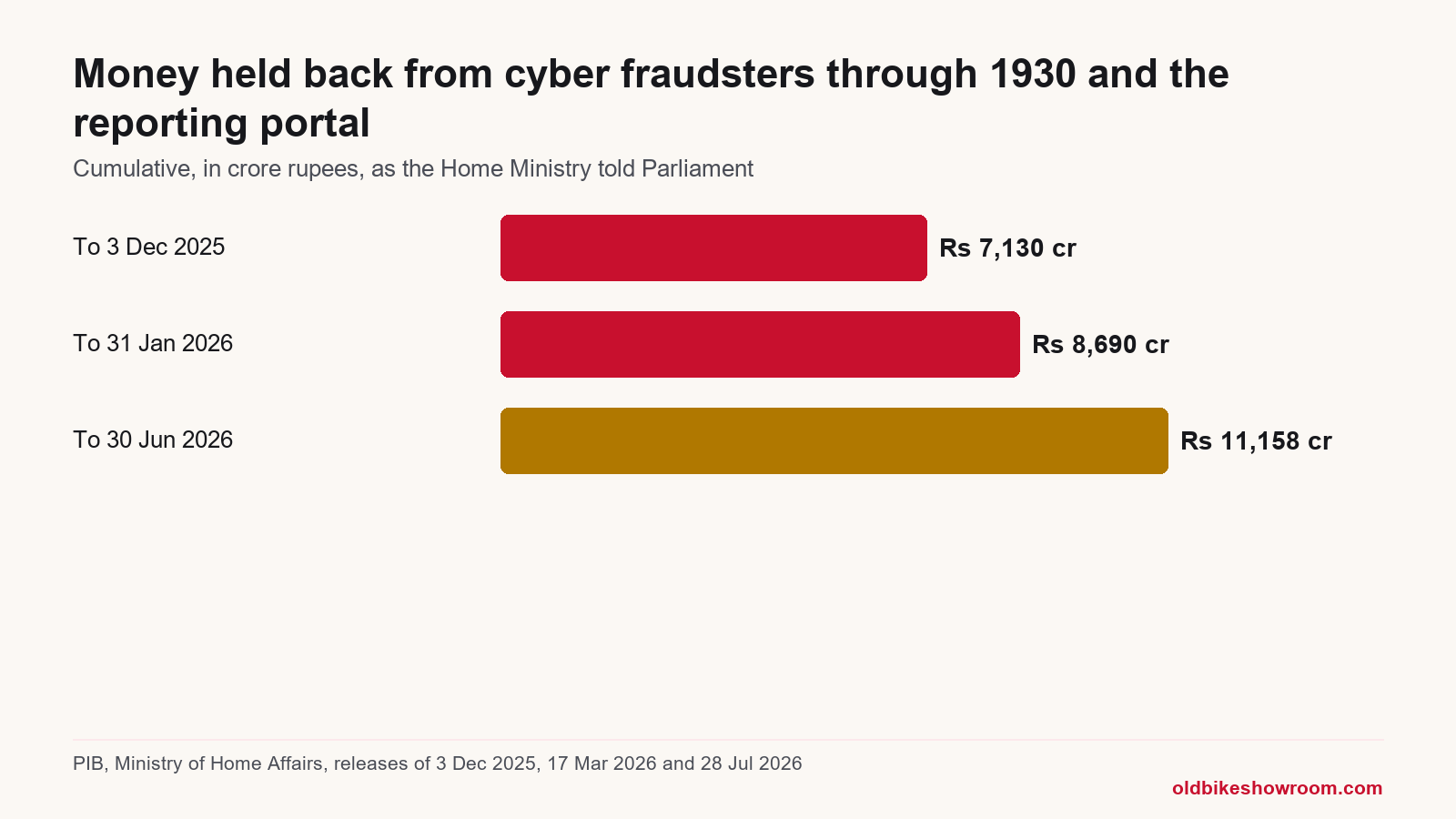
Call 1930 and file on the National Cyber Crime Reporting Portal as soon as you realise, and tell your bank. The Ministry of Home Affairs told Parliament on 28 July 2026 that the Citizen Financial Cyber Fraud Reporting and Management System, run by the Indian Cyber Crime Coordination Centre since 2021, had by 30 June 2026 saved more than Rs 11,158 crore across more than 32.80 lakh complaints, and that 1930 is the toll free number for lodging them. The same figure stood at Rs 7,130 crore on 3 December 2025 and Rs 8,690 crore on 31 January 2026. The operator raises a ticket against the account you paid, and the receiving bank holds the money if it is still there. Money already withdrawn from a mule account cannot be held, which is why the first hour matters more than the first week.
Two things changed this year: the March release says a standard operating procedure for the system was issued on 2 January 2026, and the July release says a money restoration module, for returning held funds to victims, has been functional since April 2026. Keep the listing screenshots, the chat, the UPI reference numbers and the seller’s number; the Pune case above was solved from exactly those. The Mumbai Police leaflet gives the same number, 1930, and the same portal, cybercrime.gov.in.
Which online listings are worth the trip to see?
The ones where the seller behaves like an owner: knows the registration year without looking, has the RC, the insurance and some service history to hand, lists in one city, and expects you to come and see the bike. The owner is not in Kashmir on a posting, is not getting it from the canteen, and does not need Rs 2,000 to keep it for you. Run the checklist below on the listing and the chat before you spend an afternoon on the Western line, and if the price is the only attractive thing about a listing, let somebody else have the lesson.
The other route is a bike that has already been through these checks. Every bike on the Old Bike Showroom bikes page is in the showroom at Bolinj Naka with its RC, where you can look the number up on mParivahan standing next to it, and we sit with you for the transfer forms. Call 070665 57209 before you come so the bike you want is at the front.
Red flags in an online bike listing, before you travel or pay
Tick each one you can honestly rule out from the listing, the chat and the government lookups. Any box left unticked is a reason not to send money, and most are a reason not to make the trip.
Ticks are saved on this device only. The checks follow the Mumbai Police leaflet, the Motor Vehicles Act and the government’s own lookups; a listing that passes all of them still needs the bike inspected in person.
Frequently asked questions
Can I buy a second hand bike online without meeting the seller?
You can find one online, but the purchase itself needs the bike, the original RC and the registered owner in one place. Every fraud on this page depends on the buyer agreeing to skip that meeting.
Is it safe to pay a small token to hold a bike I found online?
No. A genuine private seller has no reason to ask for money before you have seen the bike, and the Mumbai Police leaflet describes exactly this request as the point where the fraud takes the money.
What if the seller’s name does not match the name on the RC?
Then you are not dealing with the registered owner, and only the registered owner can sign Form 29. Ask to deal with the person on the RC directly, or walk away.
Can a bike bought online be transferred to my name in Virar?
Yes, through the same Vahan transfer application as any other bike, within thirty days of purchase. A bike registered outside Maharashtra also needs Form 28, the no objection certificate from its original RTO.
How do I know an online buyer for my bike is genuine?
A genuine buyer wants to see and ride the bike, pays into your account before taking it, and signs Forms 29 and 30 with you. A buyer who wants to pay before seeing it, or asks you to approve anything in your UPI app, is not buying.
Does reporting to 1930 get the money back?
Sometimes, and only if the money is still in the account it went to. The official figures count money held before it moved; once withdrawn, recovery depends on the police case, which can take months.
Finished the page? The same five questions from the top, to see what stuck.
RTO rules, fees and insurance terms change. This page was checked against the sources linked above on the date shown. Questions about a bike? Old Bike Showroom, Bolinj Naka, Virar West.
Leave a Reply