
To sell old bike or scooter safely, clear any loan first, take the full payment before the keys go, and sign Forms 29 and 30. Section 50 of the Motor Vehicles Act gives the seller 14 days to report the sale to the RTO. Until the RC shows the buyer’s name, the law still treats you as the owner.
Listen to this article, about 15 minutes. A synthetic voice reads the article and announces each section title as it begins; tables are read row by row and the questions at the end are left out.
Recorded 13 November 2026 from the article as published that day. Press a chapter to jump there; the highlighted line is what is playing. A play button sits beside every section heading, and once you scroll past this player a bar at the bottom of the screen keeps the controls in reach. Tap or click any sentence to hear the reading start from there.
On this page: the seller’s duty quoted from section 50 of the Motor Vehicles Act, the Supreme Court ruling that keeps the RC owner liable, Maharashtra’s faceless transfer step by step, and a hand over checklist.
Think you already know this? Five questions, one minute.
Every answer is on this page. Answer from what you know now; the page fills in the rest.
-
1. Within how many days must a seller report the sale of a bike registered in the same state?
Section 50(1)(a)(i) gives the transferor fourteen days; the buyer gets thirty. Motor Vehicles Act, 1988 Read the section
-
2. In Naveen Kumar v Vijay Kumar (2018), who did the Supreme Court treat as the owner?
The Court held the registered owner is the owner for the purposes of the Act, even after a sale that was never recorded. Supreme Court judgment, 6 February 2018 Read the section
-
3. Who starts a faceless transfer of ownership on Vahan in Maharashtra?
The seller initiates it with an Aadhaar OTP and enters the buyer’s details; the buyer then continues with the application number. Maharashtra process flow Read the section
-
4. According to NPCI, what does entering your UPI PIN do?
The PIN authorises transactions, so a request to enter it in order to receive money is a request to pay. NPCI UPI FAQ Read the section
-
5. Within how many days must the buyer ask the insurer to move the policy into their name?
Section 157(2) gives the transferee fourteen days to apply to the insurer. Motor Vehicles Act, 1988 Read the section
Most advice on selling a bike stops at the price. Take good photos, wash it, mention it was garage kept and ladies driven, and wait for the phone to ring. If the ad goes online, check which parts of a bike listing to keep off the photos, the number plate and the RC among them, before you post it. The part nobody writes about is what happens after the buyer rides away, because that is where sellers get hurt. Everything below was checked against the Act, the Maharashtra transport department and the Supreme Court on 8 October 2026, and the dealer rules and the July 2026 draft were rechecked on 21 October 2026.
What are the ways to sell an old bike, and how do they compare?
Three routes, each trading price against speed and against how much paperwork risk stays with you.
| Route | Price | Speed | Who chases the RC transfer | Main risk |
|---|---|---|---|---|
| Private sale to someone you meet | Usually the highest | Days to weeks | You, until the buyer applies | The buyer never transfers, or pays with a trick |
| Online listing | Similar to private | Depends on replies | You, same as a private sale | Fake buyers and payment frauds |
| Sale to a used bike dealer | Usually lower than private | Often the same day | The dealer, once the handover is reported | Choosing a dealer who does not report it |
Whichever route you take, work out a fair figure before the first call. Our guide to how a fair second hand bike price is worked out shows the IRDAI depreciation schedule every insurer uses, which is the one published number for a bike’s age. If the bike no longer runs, there is a fourth buyer the table above leaves out, and our guide to the four kinds of bike buyers near you and the form each one files covers the registered scrapping facility too.
What does the law make a seller do after the sale?
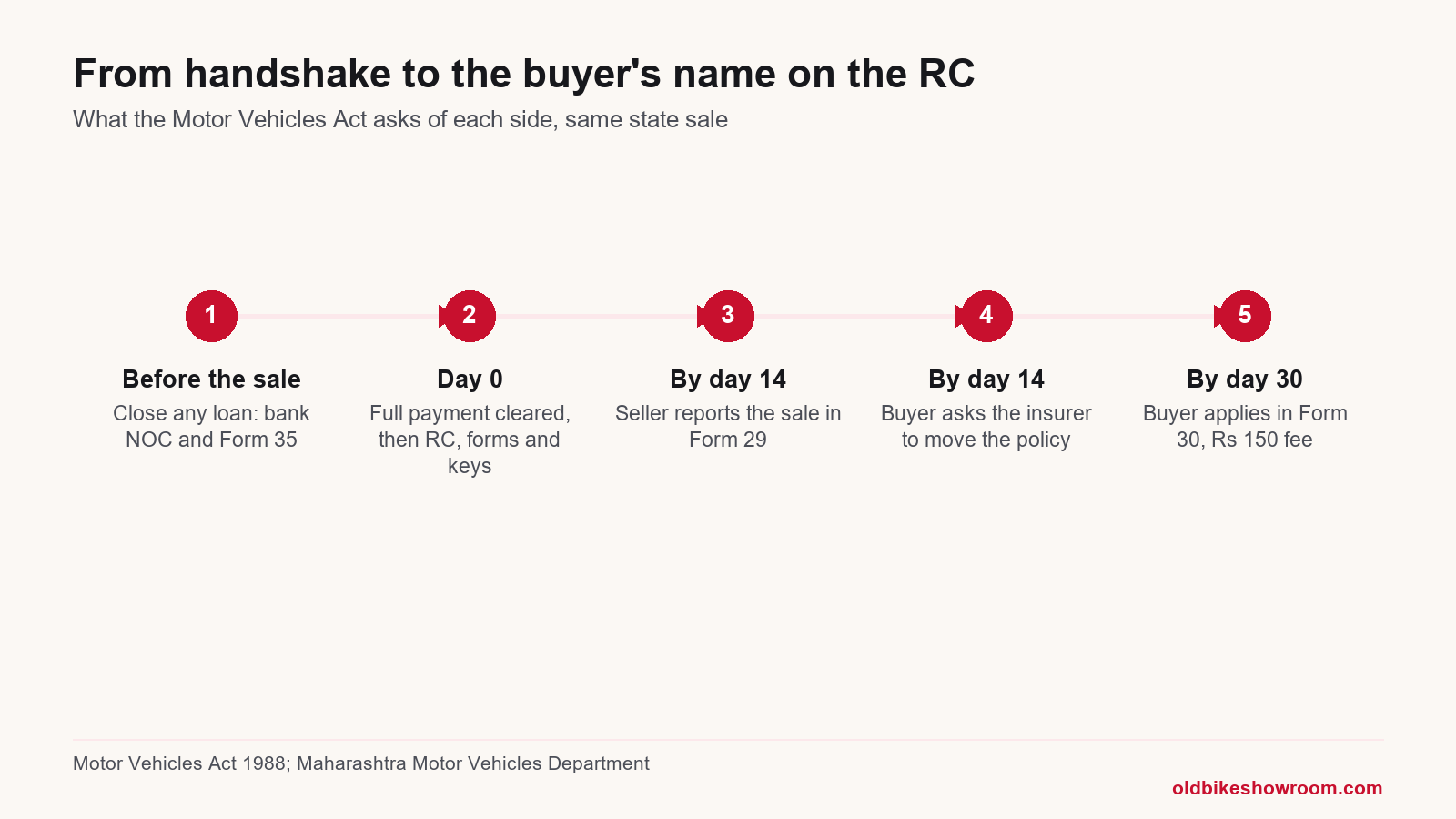
The seller’s duty is written into section 50 of the Motor Vehicles Act, 1988. For a bike registered in the same state, the transferor must report the transfer “within fourteen days” to the registering authority and send a copy of that report to the buyer. For a bike registered outside the state, the seller has forty five days and must forward the no objection certificate. The buyer then has thirty days to report the transfer and send in the RC with the fee, and our guide for buyers sets out what a buyer should sign and collect on the day of a second hand bike sale.
The report the seller files is Form 29, the notice of transfer of ownership. On the form the seller declares that the RC and the insurance certificate have been handed over and that the bike is free of encumbrances. The buyer’s application is Form 30. If either side misses its deadline, section 50(3) lets the RTO collect a late amount in place of prosecution under section 177. For the out of state sale, the central fee table in rule 81, as reproduced on the Tripura transport department’s fee page, adds Rs 300 for each month or part of a month that the no objection certificate reaches the RTO late, in the case of a motorcycle.
| Duty | Whose | Deadline | Source |
|---|---|---|---|
| Report the sale and copy the report to the buyer | Seller | 14 days, same state | Section 50(1)(a)(i) |
| Forward the NOC for an out of state bike | Seller | 45 days | Section 50(1)(a)(ii) |
| Apply for the RC transfer with the fee | Buyer | 30 days | Section 50(1)(b) |
| Ask the insurer to move the policy | Buyer | 14 days | Section 157(2) |
| Pay the Rs 150 motorcycle transfer fee in Maharashtra | Either, by agreement | With Form 30 | Maharashtra registration fees |
If the bike was bought on a loan, the bank’s NOC and Form 35 come first, so that the hypothecation is removed from the RC before the sale. Maharashtra lists hire purchase termination as nil on its fee page. The shop keeps the full RC transfer document list on its main site.
Why does the name on the RC matter so much to the seller?
Because the registered owner is the owner in the eyes of the law. In Naveen Kumar v Vijay Kumar, decided on 6 February 2018, the Supreme Court looked at a vehicle that the first owner said he had sold in 2007, papers and transfer forms included. The RC was never changed, the vehicle was uninsured, and it was in a fatal accident. The Court held that the person in whose name the vehicle stands registered is its owner for the purposes of the Act, and restored the compensation award against him.
The everyday version is a stack of challans for a bike you last saw two years ago. You can check what is recorded against your number on Parivahan e-Challan and who it is registered to on Vahan.
How does the faceless RC transfer work in Maharashtra?
Maharashtra runs a faceless transfer on Vahan in which neither side visits the RTO. The transport department’s process flow for the service, dated December 2022, sets out who can use it and the steps.
It is open only to a Maharashtra registered, individually owned, non transport bike with no loan on it, where both seller and buyer live in Maharashtra. The owner’s name, father’s or husband’s name, mobile number and pin code on Vahan must match their Aadhaar records exactly. One stray initial and you are back at the counter.
| Step | Who does it | What happens |
|---|---|---|
| 1 | Seller | Starts Transfer of Ownership on the Vahan citizen interface and authenticates with an Aadhaar OTP |
| 2 | Seller | Enters the buyer’s details exactly as on the buyer’s Aadhaar; an application number goes to the buyer’s phone |
| 3 | Buyer | Enters that number, authenticates with Aadhaar and fills in their part |
| 4 | Buyer | Pays the fee, can print Forms 29 and 30 and the receipt, and uploads the documents |
| 5 | RTO | Verifies and approves; the new RC is printed in the buyer’s name |
The seller starts it, so the application can exist before the bike leaves. If the faceless route is not open to you, the same transfer is made with signed Forms 29 and 30 at the RTO. Neither route moves the RC of a bike registered before April 2019 until its plate is fitted and recorded, so read why an older bike needs an HSRP plate before the transfer before you list it.
What changes when you sell your bike to a dealer?
Since a December 2022 amendment to the Central Motor Vehicles Rules, notified as G.S.R. 901(E), dealers of registered vehicles have their own regime. The government’s release of 28 December 2022 says it introduced an authorisation certificate for such dealers, a procedure for intimating delivery of a bike from its owner to the dealer, and the dealer’s powers and responsibilities while the bike is in its possession, including applying for the transfer of ownership.
The form has a name now. Parivahan’s own list of forms, read on 21 October 2026, lists Form 29C as the “intimation to the registering authority, about the fact of delivery of vehicle to authorized dealer of registered vehicles”, and Form 29D as the intimation about taking the bike back from the dealer. The West Bengal transport department’s order of 29 March 2023 implementing the rules, reproduced on WBXPress, treats the dealer as the “deemed transferee” until the bike is re-sold, lets it hold a bike “on the strength of Form 29/29C duly signed by the Registered Owner”, and makes it keep a movement log for each vehicle. Commentary such as VahanBazaar’s explainer adds that the dealer’s authorisation certificate is Form 29B and that filing Form 29C generates an acknowledgement number; we could not read the gazette text itself, so take those two details as reported. In practice: ask the dealer whether it holds the authorisation certificate, ask it to file Form 29C for your bike, and keep the acknowledgement. That number is what turns “I sold it to a dealer” into a record the RTO can see.
What does the July 2026 draft change for a seller who uses a dealer?
Nothing yet, because it is a draft. In July 2026 the Ministry of Road Transport and Highways published a proposed amendment to the same dealer rules for objections and suggestions. We could not read the gazette copy on 21 October 2026, and the summaries we did read do not even agree on its number: TeamLease RegTech cites G.S.R. 649(E) of 22 July 2026, Simpliance lists G.S.R. 665(E), and Corpseed dates the draft 21 July 2026. What they agree on is in the table, labelled as reported, with the summary each point comes from.
| Proposal, as reported | What it would mean for a seller | Reported by |
|---|---|---|
| Owner may take the bike back within fifteen days of filing Form 29C | A cooling off window if the dealer’s offer changes after the handover | TeamLease |
| No handover to a dealer of a bike without a valid RC, insurance and PUC, or with a loan still on it | Renew the PUC and close the loan before the dealer visit, not after | TeamLease, VahanBazaar |
| Each move between dealers recorded on a new Form 29CA, and no more than two such moves before Form 30 | The bike cannot bounce between dealers for years in your name | TeamLease, Corpseed, VahanBazaar |
| A dealer may not hold a bike beyond six months without the ownership being transferred | A clock on the dealer, not on you | Corpseed, VahanBazaar; not in the TeamLease summary |
Objections ran for thirty days from publication, and none of the summaries we read on 21 October 2026 reported a final notification. Until one appears, the 2022 rules above are what applies, and nothing in the draft loosens them. The two points worth acting on today need no new law anyway: renew the PUC and close the loan before any dealer sees the bike, and get the Form 29C acknowledgement before you leave. A bike with an engine warning lamp on may not pass that PUC test at all, and what a sensor fault does to the PUC test explains why fixing the fault first beats explaining it to a dealer.
How do you take payment for a bike safely?
Payment is where an online sale goes wrong, and none of this part is funny. Three rules cover most of it. Take the full amount before the keys, the RC or the signed forms leave your hand. Confirm a bank transfer in your own bank app, not from a screenshot the buyer shows you. And never enter your UPI PIN to receive money: NPCI, which runs UPI, says the PIN is what authorises a transaction from your account and asks users never to share it. A buyer who sends a request or a QR code for you to approve is asking you to pay.
Fake parties play both sides. The Mumbai Police cyber awareness leaflet describes online listings by people claiming to be in the Army, who send a fake canteen card and Aadhaar on WhatsApp, offer motorcycles cheap, and then demand registration fees and GST before a delivery that never comes. So the online buyer who pays a deposit to a stranger is the same story told from the other end. If you are cheated, the leaflet gives the cyber helpline as 1930. Sellers listing online face the mirror image of this, and our guide to the payment tricks fake buyers use when you sell a used bike online sets each one against the RBI and Delhi Police advisories.
What do sellers report when the RC stayed in their name?
Two dated Team-BHP posts were read for this page, carrying four accounts in all. They are what people report, not a finding about anyone, and one company named in them is not named here.
In a post from 30 May 2022, a rider who sold a bike to a used bike buying company in Pune in November 2017 found it still in their name more than four years later, with paid and pending challans showing it was in daily use. All they had was the company’s delivery note. Replies advised sending the sale papers to the RTO by registered post and a lawyer’s notice giving 15 days. Another member wrote that a bike they sold in 2015 was resold without transfer; it cost Pune to Mumbai trips to fix. They now hand over the keys only once the transfer has been started.
In a post from 11 August 2023, a seller who sold a Yamaha RX135 in Mumbai in 2015, and kept the transfer set and a delivery note, was phoned eight years later by a third owner asking for Aadhaar and PAN to reissue an expired NOC. The first buyer was untraceable. Members suggested a notarised affidavit from the new owner accepting responsibility for everything since the sale. One recalled selling to a dealer in 2019 under a written deadline of 45 days; the transfer went through in 10. A seller whose dealer has gone silent has a further route, set out in our section on what to do when a used bike shop never transfers the bike, including two consumer commission orders won by old owners.
Set against the rules, every account turns on one gap: the sale was done, but nobody saw the transfer through to the new name on the RC, which is the step section 50 puts deadlines on. The one sale that went smoothly had a written deadline.
What should a seller hand over, and what should they keep?
Hand over the original RC, a valid insurance policy and PUC, the signed forms, and the bank’s NOC and Form 35 if there was a loan. Keep copies of every signed form, a delivery note with the date, time, kilometres and the buyer’s ID, and proof of payment. Then check Vahan after a month, and do not stop checking until the name has changed. The seller who lost the service book can still sell; the seller who lost the delivery note may regret it. If you meant to throw your old helmet in with the bike, our note on why a used helmet’s drop history matters more than its shine explains why one government safety scheme asks owners not to pass a replaced helmet on.

If you would rather not do the chasing, you can tell us about your motorcycle or scooter on the sell your bike page and we will reply with a price. For buyers, the guide on what to check before you pay for a second hand bike is the other half of this page, and what goes into an on road bike price shows what a used bike has already paid. Either way, come to the showroom at Bolinj Naka, Agashi Road, Virar West, or call 070665 57209 before you come.
Seller’s hand over and keep checklist
Tick each item as you go. Hand over the first group, keep the second, and do not stop at the handshake.
Built from sections 50 and 157 of the Motor Vehicles Act and Maharashtra’s transfer pages, read on 8 October 2026. Nothing you tick is stored or sent.
Frequently asked questions
Can I sell a bike that still has a loan on it?
Only after the loan is closed and the hypothecation is removed. The bank’s NOC and Form 35 go to the RTO first; Maharashtra lists that termination as free.
Who pays the RC transfer fee when I sell?
The Act does not say. Maharashtra charges Rs 150 for a motorcycle transfer, so agree in writing who pays it and who clears pending challans.
Does my insurance move to the buyer automatically?
Section 157 deems the policy transferred on the date of sale, and the buyer must apply to the insurer within 14 days to have it changed.
What if I sell to a buyer in another state?
Section 50 gives the seller 45 days in that case, with the no objection certificate. The faceless Maharashtra route is not open when either party lives outside the state.
Is a delivery note a legal requirement?
No form in the rules is called a delivery note, but a dated and signed note with the buyer’s ID is the seller’s best record of when the bike left.
How do I know the transfer is complete?
Search the registration number on Vahan. The transfer is done when the owner shown is the buyer, not when the forms are signed.
Finished the page? The same five questions from the top, to see what stuck.
RTO rules, fees and insurance terms change. This page was checked against the sources linked above on the date shown. Questions about a bike? Old Bike Showroom, Bolinj Naka, Virar West.
Leave a Reply