
Old vintage bikes are a legal category in India only once a motorcycle or scooter is more than 50 years old from its first registration and still in original form. Such a bike can be registered in the VA series for Rs 20,000, valid ten years, but may not be ridden for regular or commercial use.
Listen to this article, about 20 minutes. A synthetic voice reads the article and announces each section title as it begins; tables are read row by row and the questions at the end are left out.
Recorded 14 November 2026 from the article as published that day. Press a chapter to jump there; the highlighted line is what is playing. A play button sits beside every section heading, and once you scroll past this player a bar at the bottom of the screen keeps the controls in reach. Tap or click any sentence to hear the reading start from there.
On this page: the vintage motor vehicle rules quoted from G.S.R. 492(E) of 15 July 2021 as read on 14 October 2026, a table setting them beside the ordinary RC rules for a bike under and over 15 years old, the place where the Parivahan fee page and the reported renewal fee disagree, and what buyers of old bikes reported between March and September 2026.
Think you already know this? Five questions, one minute.
Every answer is on this page. Answer from what you know now; the page fills in the rest.
-
1. Under rule 81A, from what date is a bike’s fifty years counted?
Rule 81A in G.S.R. 492(E) defines a vintage motor vehicle as more than fifty years old from the date of first registration after first sale. Read the section
-
2. What does rule 81B(3) say about a bike already registered as vintage?
Rule 81B(3) of G.S.R. 492(E) says vehicles already registered as vintage keep the original registration number and plate intact, and 81B(4) exempts them from the high security plate. Read the section
-
3. What does rule 81E allow for a vintage registered bike?
Rule 81E of G.S.R. 492(E) says vintage motor vehicles shall not be driven or plied on the roads for regular purposes and shall not be used for any commercial purposes whatsoever. Read the section
-
4. Within how many days must the buyer and seller of a vintage registered bike inform the authority?
Rule 81D of G.S.R. 492(E) makes it the joint responsibility of buyer and seller to submit the information within ninety days of the sale. Read the section
-
5. How is the insured value of a bike over five years old fixed?
The schedule in a two wheeler policy wording filed with IRDAI stops at five years; beyond that, and for obsolete models, the IDV is determined by an understanding between insurer and insured. Read the section
Everybody selling an old bike calls it vintage. A 2004 Bullet is vintage, a 1990s RX100 is vintage, and a Yezdi with an odometer that has stopped at a suspiciously round 9,000 is very vintage indeed. The law is stricter. Since July 2021 the Central Motor Vehicles Rules carry a chapter for vintage motor vehicles, with its own age test, plate, fee and one condition most buyers never hear about. This page quotes it, read on 14 October 2026, beside the ordinary rules for a bike that is merely old, and since 14 November 2026 it also works out what Maharashtra charges to keep a bike over fifteen on the road. Bike, as everywhere on this site, means a motorcycle or a scooter.
When does an old bike legally count as vintage?
The definition sits in rule 81A, added by the gazette notification G.S.R. 492(E) of 15 July 2021, the Central Motor Vehicles (Fifteenth Amendment) Rules, 2021. A vintage motor vehicle is an L1 or L2 two wheeler, or an M1 car, that is “more than fifty years old from the date of first registration”, including an imported one. Then comes the condition: it must be “maintained in its original form” and must not have had a substantial overhaul, which the rule says includes any modification in chassis or body shell or engine.
Count the years from the first registration, not from the year painted on the tank or the year the seller remembers. On 14 October 2026 that means a bike first registered on or before 14 October 1976 can qualify. Most bikes sold as old vintage bikes in Virar and Vasai fail that test by decades: a 1985 bike is 41, a 1996 bike is 30. They are old bikes under the ordinary rules. And a bike that has had its engine swapped for a newer one is out of the vintage category whatever its age, which ties in with section 52 of the Act on alterations, covered in our page on what refurbished really means on a used bike.
How do you register a vintage bike at the RTO?
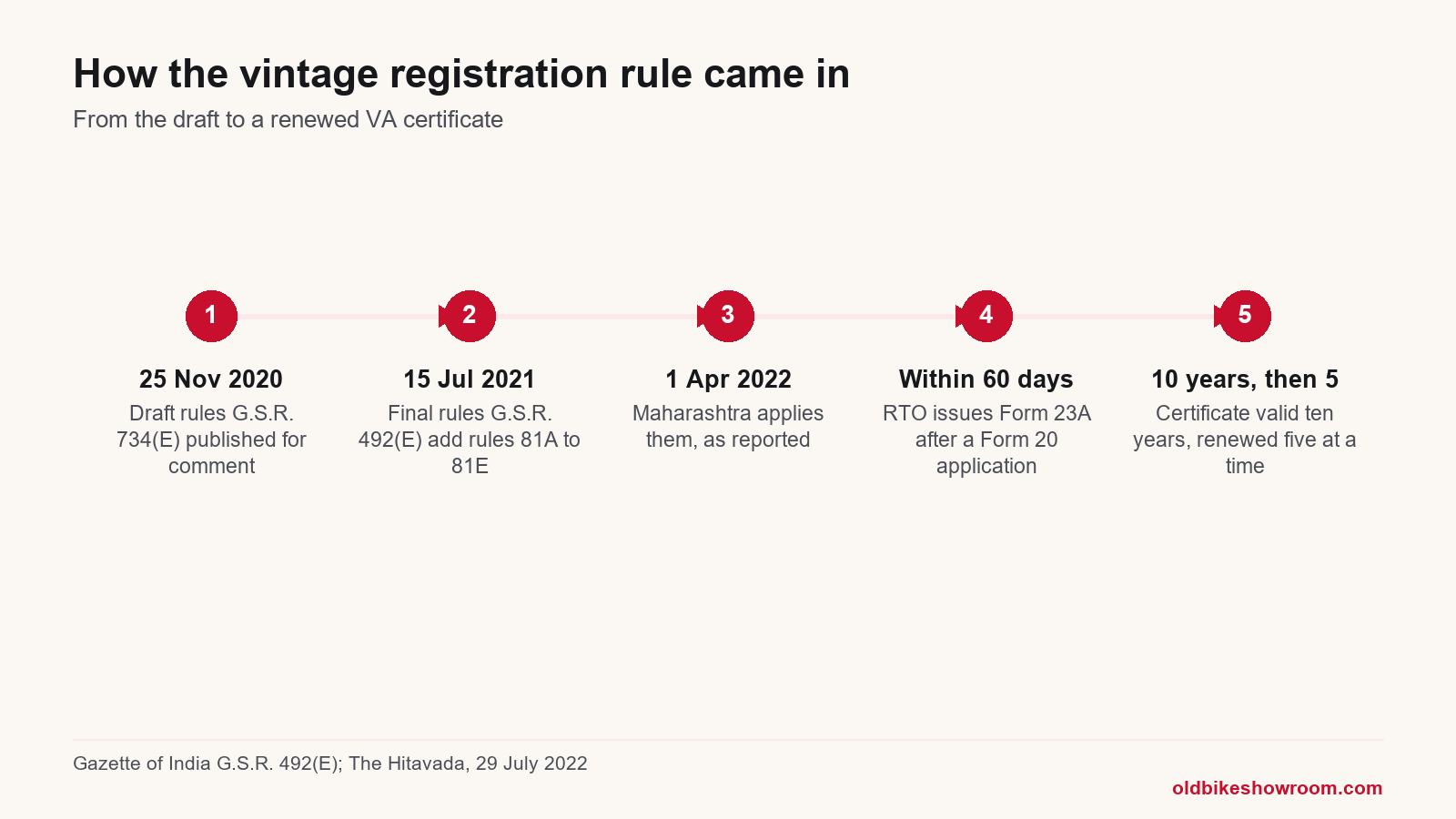
Rule 81A sets the paperwork. The application is made on Form 20 and must carry a policy of insurance, the fee, a Bill of Entry for an imported bike, and the old RC if the bike is already registered in India. The State Registering Authority then issues a certificate of registration in Form 23A “within a period of sixty days”. The old RC is cancelled, and the rule lets the owner keep the cancelled certificate “for historical purposes only”.
A fresh registration gets a mark in the form XX VA YY followed by a number from 0001 to 9999, where VA stands for vintage and XX is the state code, so a Maharashtra bike would read MH VA and then the series. Rule 81B(3) says vehicles already registered as vintage keep their original number and plate “without any change”, and 81B(4) exempts all of them from the high security registration plate. The fees were added to the Rule 81 table: Rs 20,000 to register and Rs 5,000 to re-register or renew. Under rule 81C the certificate is valid for ten years and renewable for five years at a time after that.

Maharashtra put the rules into effect from 1 April 2022, according to a report in The Hitavada of 29 July 2022. The same report shows where it gets messy, and the lived experience section below comes back to it.
Can you ride a vintage registered bike every day?
No. Rule 81E is one sentence long: vintage motor vehicles “shall not be driven or plied on the roads for regular purposes” and shall not be used for any commercial purpose at all. The Press Information Bureau summary of 18 July 2021 says the same. A VA plate is a museum pass, not a commuter’s licence. If the plan is to ride the bike to the station every morning, the vintage route is the wrong one.
That is why most owners of old bikes stay on ordinary registration. Section 41(7) of the Motor Vehicles Act, 1988 makes a private vehicle’s RC valid for fifteen years, and section 41(10) lets the RTO renew it for five years at a time. The renewal fee is where the official pages disagree with each other. The Parivahan fees and user charges page still printed “Rupees Three Hundred” for issue or renewal of a motorcycle RC when read on 14 October 2026, while Autocar India reported that the 2021 fee notification raised renewal for a motorcycle over 15 years to Rs 1,000 from 1 April 2022, with Rs 300 for each month of delay. On 14 November 2026 the Parivahan page also carried a separate Rs 2,000 row for a motorcycle more than 20 years old, and Maharashtra had doubled its green tax on old bikes; the section on what it costs to keep a bike over 15 years old legal works through both.
| Question | Old bike under 15 years | Old bike over 15 years | Registered vintage, over 50 years |
|---|---|---|---|
| Rule that applies | Section 41(7), MV Act | Section 41(10), MV Act | Rules 81A to 81E, G.S.R. 492(E) |
| RC validity | 15 years from issue | 5 years per renewal | 10 years, then 5 per renewal |
| Fee to renew | Not due yet | Rs 300 on Parivahan, Rs 1,000 as reported | Rs 5,000 |
| Number plate | Ordinary series | Ordinary series | VA series, or original number if already vintage |
| Daily riding | Allowed | Allowed | Not for regular or commercial use |
| Time to report a sale | 14 days seller, 30 days buyer | 14 days seller, 30 days buyer | 90 days, buyer and seller jointly |
What does it cost to keep a bike over 15 years old legal?
Most old bikes on sale around Virar are not fifty. They are fifteen to thirty, and the date that decides what they cost to keep is printed on the RC, not on the tank. Section 41(7) of the Motor Vehicles Act makes a private bike’s RC “valid only for a period of fifteen years”, and section 41(10) lets the RTO renew it “for a period of five years”, subject to section 56, which is the inspection. Maharashtra’s own registration guide says the same: the renewal is granted after the vehicle is inspected. So a 2010 bike is due its first renewal and a 1996 bike may be on its fourth, and each one is a trip to the RTO with the bike, not a form sent from home.
The official pages do not agree on the first item of the bill. The Parivahan fees and user charges page, which says it was last updated on 8 October 2026, still printed Rs 300 for issue or renewal of a motorcycle RC when we read it on 14 November 2026, and below that a separate row of “Two thousand rupees” to renew a motorcycle “older than 20 years from date of first registration”. It prints nothing for the years in between. The Central Motor Vehicles (Third Amendment) Rules, G.S.R. 568(E) of 21 August 2025, as summarised by TeamLease RegTech, reworded the existing renewal entry to cover vehicles “older than 15 years but not exceeding 20 years”, and Autocar Professional reported that the two wheeler fee went to Rs 2,000 from Rs 1,000. Read together, a motorcycle between 15 and 20 years old is reported at Rs 1,000 and one over 20 at Rs 2,000. We could not open the gazette itself today, so the Rs 1,000 band is a reported figure, and the Vahan payment screen shows the fee that actually applies.
Then comes Maharashtra’s own charge. The Maharashtra Motor Vehicles Tax (Amendment) Bill, 2026 raised the environment tax on a two wheeler from Rs 2,000 to Rs 4,000 as one payment covering five years, the Free Press Journal reported on 18 March 2026. The Hitavada reported on 11 April 2026 that the new rates took effect from 6 April 2026, at Rs 2,000 for a BS-VI bike and Rs 4,000 for BS-IV and older. For the bikes on this page that split does not help. A two wheeler turning 15 in November 2026 was first registered in 2011, years before BS-IV became compulsory for new two wheelers in April 2017, so every bike past fifteen today sits in the Rs 4,000 band.
The Parivahan table adds two smaller lines: Rs 200 more when the RC is issued as a smart card, and “an additional fee of Rupees Three Hundred Only for delay of every month or part thereof in respect of motor cycles”. Some states add an inspection charge on top; the Odisha transport fee table lists a Rs 200 fitness fee and a Rs 200 inspection fee on a motorcycle renewal. We found no Maharashtra page that lists one either way.
| Cost | Amount | Source |
|---|---|---|
| RC renewal, motorcycle 15 to 20 years old | Rs 1,000 as reported; Parivahan still prints Rs 300 | G.S.R. 568(E), 21 August 2025; Parivahan fee table, read 14 November 2026 |
| RC renewal, motorcycle over 20 years old | Rs 2,000 | Parivahan fee table, item 16, read 14 November 2026 |
| RC issued as a smart card | Rs 200 extra | Parivahan fee table, Note 1 to item 4 |
| Renewal applied for late | Rs 300 for every month or part of a month | Parivahan fee table, Note 2 to item 4 |
| Maharashtra green tax, BS-IV and older | Rs 4,000 for five years, from 6 April 2026 | Free Press Journal, 18 March 2026; The Hitavada, 11 April 2026 |
| Riding on a lapsed registration | Rs 2,000 to Rs 5,000, first offence | Motor Vehicles Act, section 192(1) |
Two worked figures, using only those numbers. A 2010 commuter whose RC runs out in December 2026 and is renewed on time pays Rs 1,000 for the renewal, Rs 200 for the smart card and Rs 4,000 green tax: Rs 5,200, or Rs 4,500 if Vahan charges the Rs 300 Parivahan still prints. A 1978 Bullet whose RC ran out in 2018 and is renewed now, about 96 months late, pays Rs 2,000, Rs 200, 96 months at Rs 300, which is Rs 28,800, and Rs 4,000 green tax: about Rs 35,000, before insurance and before any green tax the RTO counts for the lapsed years, which we could not confirm either way. That Bullet is also where the fifty year rule comes back. First registered in 1978, it crosses fifty in 2028, when a VA registration costs Rs 20,000 for ten years but allows only display and rallies under rule 81E. Renewing it now keeps it a bike you can ride; the VA plate makes it an exhibit.
Owners describe the same costs from the counter side. We read three r/IndianBikes threads from January to September 2026, with about a dozen replies between them; these are what people report, paraphrased, not findings. In a January 2026 thread a Maharashtra owner asked how to renew a 15 year old bike’s RC. One reply described the RTO visit: ride the bike briefly in front of an inspector who checks the low and high beam, indicators, brake lights and horn, then receive a five year RC by post in about 15 days. The owner came back to say an agent had quoted Rs 8,000, and nobody in the thread said how much of that was government fees. Against the roughly Rs 5,200 worked out above, most of that quote looks like the agent’s charge, though the thread never split it.
In a September 2026 thread about a Hero Honda Super Splendor reaching fifteen, one reply put the cost in Chandigarh at about Rs 1,800 in fees plus Rs 500 for a fitness certificate from the Hero dealer, in a state with its own taxes. And in a September 2026 thread about that 1978 Bullet in Maharashtra, one reply worked out a fine of Rs 10 a day, about Rs 30,000 over eight years, and said the Royal Enfield dealer charged Rs 500 for a fitness certificate to take to the RTO; another said the penalty differs by state, Rs 300 a month in some. The two readings land within about a thousand rupees of each other over eight years, and the Rs 300 a month is the one Parivahan prints. The dealer fitness certificate appears in two of the three threads, though the Parivahan renewal page marks a fitness certificate as needed only in some states.
A third reply in the Bullet thread said theirs had expired in 2016 and was still on the road. That is the part not to copy. Section 39 of the Act bars driving a vehicle that is not registered, and section 192(1) punishes it with a fine of not less than Rs 2,000 and up to Rs 5,000 for a first offence, and up to a year in jail or a fine of Rs 5,000 to Rs 10,000 for a repeat. A lapsed RC also blocks a sale, because the renewal and its late fee come before any transfer, and an older bike usually needs its high security plate sorted on Vahan too, which our guide to the HSRP check before a transfer covers.
For a buyer the practical step is short. Read the validity date on the RC before you look at the paint, and price the renewal into your offer: a bike with two months left on its RC costs about Rs 5,000 more than its price tag in Maharashtra, and one that lapsed years ago carries every month of late fee with it. If the bike came from another state, the road tax question is separate again, and our page on registering a bike in another state to save road tax explains why that trick does not work.
What should you check before buying an old vintage bike?
Start with the paper, because the paper is the part you cannot restore. The RC should carry a frame number and an engine number that match the metal, and its validity date should be in the future. A registration that lapsed years ago is not a formality; it has to be renewed, with arrears, before the bike can be transferred, and an RC with someone else’s name and no seller who can sign Forms 29 and 30 is not something an affidavit fixes. Ask whether the bike was ever police, government or auction property, because that history can stop a re-registration outright, as one buyer below found out.
Then the metal. The classic Indian makes have long histories: Royal Enfield’s own history page dates its Madras partnership to 1955, with Bullets built at Tiruvottiyur from the next year, and Jawa’s legacy page says the Mysore factory opened in 1961 and built the 250 Type 353/04 under licence until 1971. Those are the manufacturers’ accounts. What they mean for a buyer is that many parts are decades old or reproduced, so a bike sold as original deserves a slow look at the engine casing, the tank, the chrome and the electrics. Our checklist for any second hand bike covers the general mechanical checks; the checklist on this page adds the vintage ones.

Checks before buying an old vintage bike
Tick each one only when you have seen it on paper or on the bike yourself. An unticked box is a question to settle before any money changes hands.
Built from rules 81A to 81E of G.S.R. 492(E), sections 41 and 50 of the Motor Vehicles Act and the IRDAI filed policy wording, as read on 14 October 2026. It records what you have seen; it does not judge any bike or seller.
How do you buy or sell a bike that is already registered as vintage?
Rule 81D allows it, with one difference from an ordinary sale. The buyer and the seller must each inform their State Transport Authority, the new owner’s name must be recorded, and it is “the joint responsibility of both buyer and seller” to submit that information within ninety days. For an ordinary bike, section 50 of the Act gives the seller fourteen days to report a transfer within the same state and the buyer thirty days to apply. Rule 81A(4) sends the transfer application itself through the normal Motor Vehicles Act process and fees, so the documents are the usual ones, listed on the shop’s RC transfer documents page.
Insurance needs a conversation, not a lookup. The IDV schedule in a two wheeler policy wording filed with IRDAI stops at five years. For anything older, and for “obsolete models” the maker has discontinued, the IDV is “determined on the basis of an understanding between the insurer and the insured”. On a bike worth more as a classic than as transport, agree that value in writing before you pay the premium, or a total loss is settled on a figure you never discussed.
What do people buying old bikes actually report?
We read three r/IndianBikes threads from March to September 2026 and one newspaper report from 2022. These are what people report, paraphrased, not findings. The pattern is plain: the engine was rarely the problem that stopped anyone. The paper was.
In a March 2026 thread, a buyer hunting for an older Bullet found a 2004 bike from a police auction whose registration had long lapsed. They asked the RTO, who told them it could not be re-registered because it had been a police bike, and advised against buying. In a September 2026 thread, a 21 year old student wanted a 1998 Kawasaki whose registration had not been renewed since 2013. The owner would hand it over only after a transfer into the buyer’s name, and refused an affidavit or a power of attorney; the buyer, rightly, would not touch the chassis number. The only reply pointed them to an agent rather than to any rule.
The July 2026 thread is the mechanical side. The poster’s grandfather’s Yezdi, about 40 years old, had been restored several times, and each time the chrome faded again because it was not hard chrome, and the engine or gearbox gave trouble again. And in Nagpur, The Hitavada reported in July 2022 that a vintage club secretary accused the RTO of issuing new VA numbers to bikes and cars that already had valid old papers, against rule 81B(3); the Assistant RTO replied that only vehicles without papers had been re-registered. Set against the rules, the accounts agree on one point: check the registration history before the restoration budget, and ask the RTO which part of rule 81B it is applying before you hand over an old RC.
Is an old vintage bike a sensible buy?
It can be, when you know which kind of old you are buying. A 50 year old bike in original form can be registered and kept for display and vintage rallies, with a VA plate and a Rs 20,000 fee. A 30 year old bike is an ordinary old bike, ridden on an RC renewed every five years, and worth what any fair second hand bike price would say plus whatever rarity a buyer will pay for. The single owner, garage kept, never raced listing describes neither until the RC agrees. If you are selling one, our guide to selling an old bike safely covers the payment and the forms, and the buyer’s deadlines are in our guide to buying a second hand bike.
If what you want is an old bike to ride rather than to exhibit, every bike on the Old Bike Showroom bikes page is at the showroom with its RC, and you can check the registration date on it before anything else. Call us on 070665 57209 before you come to Bolinj Naka, Agashi Road, so the bike you want to see is ready at the front.
Frequently asked questions
How old does a bike have to be to count as vintage in India?
More than fifty years from its first registration, under rule 81A of the Central Motor Vehicles Rules, and it must still be in original form with no substantial change to the chassis, body shell or engine.
What does a VA number plate mean?
VA stands for vintage. A fresh vintage registration gets a mark in the form state code, VA, a two letter series and a number from 0001 to 9999, under rule 81B.
Does a vintage bike need a high security registration plate?
No. Rule 81B(4) exempts every registered vintage motor vehicle from the high security registration plate requirement in rule 50.
Can a vintage registered bike be insured?
Yes, and an insurance policy must accompany the application. For bikes over five years old or discontinued models, the insured value is agreed between the insurer and the owner.
Is a 1990s RX100 or Yezdi a vintage bike legally?
Not yet. A bike first registered in the 1990s is about 30 years old, so it stays on ordinary registration with five year RC renewals until it passes the fifty year mark.
Can a modified old bike be registered as vintage?
Not if the modification is substantial. Rule 81A excludes vehicles whose chassis, body shell or engine has been modified, so a bike with a swapped engine does not qualify.
Finished the page? The same five questions from the top, to see what stuck.
RTO rules, fees and insurance terms change. This page was checked against the sources linked above on the date shown. Questions about a bike? Old Bike Showroom, Bolinj Naka, Virar West.
Leave a Reply