
To sell used bike online safely, never scan a buyer’s QR code or enter your UPI PIN to receive money, check the credit in your own bank app rather than a screenshot, and hand over the keys, RC and signed forms only after full payment. Then report the sale to the RTO within 14 days, as section 50 requires.
Listen to this article, about 14 minutes. A synthetic voice reads the article and announces each section title as it begins; tables are read row by row and the questions at the end are left out.
Recorded 11 November 2026 from the article as published that day. Press a chapter to jump there; the highlighted line is what is playing. A play button sits beside every section heading, and once you scroll past this player a bar at the bottom of the screen keeps the controls in reach. Tap or click any sentence to hear the reading start from there.
On this page: a table of seven payment tricks aimed at online bike sellers, each quoted from the RBI and Delhi Police advisories read on 25 October 2026 with the one check that exposes it, five dated seller accounts, and a hand over checklist.
Think you already know this? Five questions, one minute.
Every answer is on this page. Answer from what you know now; the page fills in the rest.
-
1. According to the Delhi Police cyber cell, how is the fake payment screenshot a buyer sends usually made?
The page says the screenshot is generated using a spoof app, which is why only a credit in your own bank app counts. Delhi Police cyber cell Read the section
-
2. What does the RBI booklet say about entering a PIN to receive money?
The booklet says there is no need to enter a PIN or password anywhere to receive money. RBI BE(A)WARE booklet Read the section
-
3. In the Pune case reported on 7 May 2026, how did the man get away with the seller’s motorcycle?
He came to inspect the bike and rode away under the guise of a test drive; police later recovered it. Punekar News Read the section
-
4. Within how many days must the seller report a same state sale to the registering authority?
Section 50 gives the transferor fourteen days for a bike registered in the same state; the buyer then has thirty. Motor Vehicles Act, 1988 Read the section
-
5. Which helpline numbers does the RBI booklet give for reporting a fraud?
The booklet says to dial 155260 or 1930, or report on the National Cybercrime Reporting Portal, after blocking debits. RBI BE(A)WARE booklet Read the section
Writing the listing is the easy part. Single owner, ladies driven, garage kept, odometer resting politely at 9,000 since the monsoon of some earlier year. Then the phone starts ringing, and not every caller wants the bike. Some want your money, some want your keys for a ride that does not come back, and a surprising number are dealers. This page covers what an online seller actually faces, checked against the Reserve Bank, the police and the Act on 25 October 2026.
Where can you sell a used bike online, and who will call you?
Most sellers use one of three online routes. None of them is a safe choice or a risky one by itself; the risk sits in the payment and the paperwork, which are the same on all three.
| Online route | Who usually calls | Price you can expect | Who files the RC transfer |
|---|---|---|---|
| Free classified listing or marketplace group | Private buyers, dealers, and fake buyers | Usually the best, after haggling | You and the buyer, under section 50 |
| Instant quote buying site or app | The platform’s own inspector | Usually lower than a private sale | The buyer company, if it is an authorised dealer |
| A local used bike dealer found online | The dealer | Usually lower than a private sale, often same day | The dealer, once the handover is recorded |
Before you post, work out a fair figure from how a used bike’s price is worked out, so a quick offer does not sound generous just because it is quick. If an instant quote app or a dealer calls, our guide to which bike buyers near you file which form shows the paper that should come back to you from each one. Expect a crowd. A seller in Bangalore who listed a motorcycle on two classified sites in September 2026 wrote that the calls came mostly from dealers, not riders. That is annoying rather than dangerous. The callers below are the dangerous ones.
What should your listing show, and what should stay off it?
Show the bike, all of it: both sides, the tyres, the odometer, the scratch on the tank you were hoping nobody would notice. Buyers trust an ad that admits the scratch. What the ad does not need is the bike’s identity. A registration number on its own is not secret, because anyone can type it into Parivahan’s Know your Vehicle Details service, which promises to “find out basic details about any supplied Vehicle Number”. The trouble starts when one public ad hands a stranger the number, the model, the colour, your phone number and your street together. That is a ready made kit for anyone who wants to pass off a copy of your bike, or a copy of your number, as real.
Copies of numbers do get used. ThePrint, carrying a PTI report of 23 April 2026, said Hyderabad traffic police had booked four riders who fixed other vehicles’ registration numbers to their own two wheelers to dodge fines and loan recovery agents, which led to “challans being wrongly generated against legitimate vehicle owners”. Here is what each part of a listing is for, checked on 11 November 2026.
| Part of the listing | In the ad? | Why, and the source |
|---|---|---|
| Photos of the bike, odometer and tyres | Yes, in daylight, from every side | Honest photos mean fewer surprises at the meeting, and fewer wasted trips for both sides. |
| Number plate | Cover or blur it; show it at the meeting | The number opens the bike’s basic record on Parivahan, and borrowed numbers send challans to the real owner (PTI, 23 April 2026). |
| RC copy, chassis and engine numbers | No; the buyer checks the original in person | The buyer can confirm the record themselves on Parivahan from the plate, then match the numbers on the frame against your original RC. |
| Your Aadhaar | Never; a masked copy only once the sale is agreed | UIDAI: in masked Aadhaar “first 8 digits of Aadhaar number are masked”, only the last 4 show, and it comes with e-Aadhaar. |
| Home address or where the bike is parked | No; give the area, meet at a busy place | The Pune Meteor 350 in Punekar News, 7 May 2026 was taken from a seller who let a stranger ride away. |
| Phone number | Use the platform’s chat first if it has one | Pune RTO’s alert in the Free Press Journal, 11 December 2025: pay fines only through authorised government websites, never a link in a message. |
Blurring the plate does not make the number secret. It is printed on the bike and the bike goes out on the road every day. The point is narrower: your ad should not be the one place where the number, the exact bike and your phone number sit side by side for anyone to copy. A genuine buyer loses nothing by seeing the plate and the RC at the meeting, and a fake one loses a lot.
Two riders on r/indianbikes describe what the number alone can do; they are what people report, not findings, and neither ties the trouble to an online ad. In a January 2026 thread, a rider got an e-challan text carrying the correct bike number, sent from an ordinary mobile number with a shortened link and no official sender ID. Checks on Parivahan, the mParivahan app and the state e-challan portal showed nothing pending, and the rider wondered whether someone had photographed the plate. In an October 2026 thread, a Hyderabad owner received a challan for a fake number plate offence with a photo of a bike that was not theirs, in a place they had never been. The one practical reply pointed them to a grievance on the Parivahan portal.
Both match the official line: the Pune RTO says to pay only on government websites, and the Hyderabad police say borrowed numbers land challans on genuine owners. What the accounts add is the order of events. The fake text arrived just as the rider got home from a short ride. Speed is the trick, the same as with the payment calls below. So once your ad is live, treat any “challan pending” message with a link as fake until the official portal says otherwise.
Which payment tricks do fake buyers use on online sellers?
This table is the reason this page exists. Each row is a trick aimed at sellers, the official advisory’s own words on it, and the one check that exposes it. The RBI’s BE(A)WARE booklet and the Delhi Police cyber cell’s OLX fraud page were both read on 25 October 2026.
| What the buyer does | What the advisory says | The one check |
|---|---|---|
| Sends a UPI request and asks you to approve it to get paid | RBI: fraudsters “insist that the seller approve the request by entering UPI PIN” | Receiving money never needs your PIN. A PIN screen means you are paying. |
| Sends a QR code for you to scan to receive the money | RBI: “Never scan any QR code to receive money” | If your app shows Pay and an amount, you are the one paying. |
| Sends a payment screenshot or a credit message | Delhi Police: the screenshot is “generated using PayTM Spoof App or similar Apps” | Open your own bank app or statement. Only a credit there counts. |
| Says a debit was a mistake and sends a bigger QR to fix it | Delhi Police: he sends “a QR code for twice the amount” | Stop at the first debit. No refund is ever made by you paying again. |
| Claims to be in the Army or posted far away, so he cannot come | RBI: “Many fraudsters pretend to be defence personnel posted in remote locations” | A buyer who cannot see the bike is not buying the bike. |
| Asks you to install an app so he can guide the payment | RBI: fraudsters “trick the customer to download a screen sharing app” | No buyer needs to see your phone screen to pay you. |
| Rushes you, or asks you to pay a small fee first | Delhi Police: “unreasonable hurry or urgency” marks “a likely fraudster” | A genuine buyer can wait while you check your bank app. |
The odd thing is how polite these calls are. The fake buyer agrees to your price without haggling, which is the first thing no real buyer of a used motorcycle has ever done.
Why does a genuine buyer never need your UPI PIN or a QR scan?
Because the PIN is the key to your account, not a receipt for theirs. The RBI booklet puts it in one line: “there is no need to enter PIN / password anywhere to receive money”. When a buyer pays you by UPI, they enter their own PIN on their own phone, and the money appears in your account. You do nothing except check that it arrived.
A QR code works the same way in reverse. The booklet says QR codes “have account details embedded in them to transfer money to a particular account”. The account in a buyer’s QR code is the buyer’s. Scan it, approve it, and your money goes to them. So the honest ways to be paid for a bike are a bank transfer you can see in your own app, a UPI payment the buyer makes to your UPI ID, or cash counted in front of you. Anything else is a story, and a story is not a payment.
What can go wrong when an online buyer asks for a test ride?
The other online trick needs no phone at all. Punekar News reported on 7 May 2026 that a Pune seller listed a Royal Enfield Meteor 350, worth about Rs 1,00,000, on a classified site. On 10 March 2026 a man came to inspect it and rode away under the guise of a test drive. Police traced him through the listing account, the call records of the linked number and CCTV footage across a 20 kilometre stretch, and recovered the bike after his arrest.
The bike came back, which is the good part, and it took the police about two months. A few simple habits close that gap: meet in daylight at a busy place, ask to see the buyer’s licence and keep a photo of it, go along as pillion or keep the buyer’s own vehicle and its key with you, and never let a test ride start before you have seen the person’s face and ID. A serious buyer will not mind.

Before you hand over the keys
Tick each item before the bike leaves. If any line is unticked, the keys stay with you.
Built from the RBI BE(A)WARE booklet, the Delhi Police OLX page and section 50 of the Motor Vehicles Act, read on 25 October 2026. It cannot tell you whether a buyer is genuine and it does not value a bike. Nothing you tick is stored or sent.
What do people who sold online actually report?
Five public Reddit threads from August to October 2026 were read for this section. They are what people report, not findings, and three of them are about selling furniture or other items rather than a bike. They are here because the trick is exactly the one bike sellers get.
In r/UPI in October 2026, a seller was asked to scan a code to receive Rs 5. The Rs 5 really arrived. The buyer then sent a Rs 25,000 code to scan the same way; the seller refused, and the buyer turned abusive. Replies explained that the small credit is bait: a genuine receipt makes the next scan feel safe.
In r/IsThisAScamIndia in August 2026, a seller received Rs 1 and Rs 10 through a so called merchant refund, then scanned a code and entered the PIN, and Rs 8,500 left the account. A second “refund” process took Rs 800 more, Rs 9,300 in all. The seller filed on the national portal, called 1930 and told the bank as soon as they realised.
In r/LegalAdviceIndia in October 2026, a colleague posting for a Bangalore seller described QR codes, “verification” steps and fake payment screenshots ending in five debits of Rs 56,890 in total. Against the pattern, one reply said a similar loss of about Rs 10,000 was returned after a cyber complaint was filed quickly.
Two bike threads show the quieter side. The September 2026 Bangalore seller was told in replies that until the RC moves, the seller stays responsible for the bike, and one suggested asking any buyer to commit to a transfer within a week. In another thread that month, replies to an owner of a seven month old motorcycle said instant sale apps pay less but handle the RTO papers, while classifieds pay more and leave the papers to you.
The accounts agree with the RBI and the police on every point: the PIN and the QR code did the damage. What the advisories do not mention is the small genuine credit sent first, which appears in two of the three loss accounts and is the part that made careful people scan.
Which papers close an online sale, and by when?
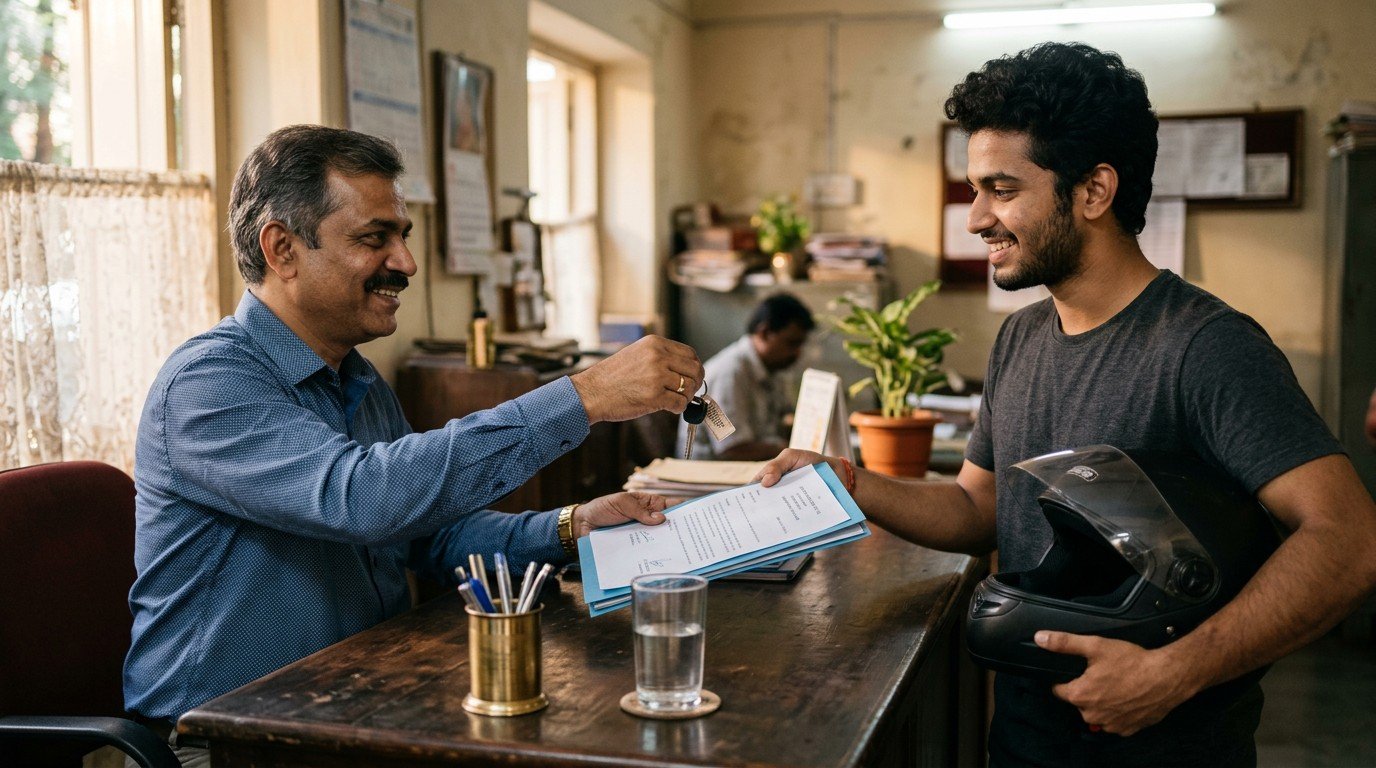
Payment is half the job; the RC is the other half. Section 50 of the Motor Vehicles Act, 1988 says the seller must report the transfer “within fourteen days of the transfer” when the bike is registered in the same state, and send a copy to the buyer; the buyer then has thirty days to apply. Our guide to the seller’s papers and the 14 day rule walks through Forms 29 and 30 and Maharashtra’s faceless transfer, and the shop keeps the full RC transfer document list on its main site.
For an online sale, two habits matter more than in a sale to a neighbour. Write a dated delivery note with the time, the kilometres and the buyer’s ID, and keep a copy of every signed form. And do not hand over signed blank forms to a buyer you met through an app, because those forms are the only proof of when the bike stopped being yours.

What should you do if a fake buyer has already taken money?
Act the same hour, because speed is the one thing that helps. The RBI booklet says to block debits on the account through the bank’s official customer care, then dial 1930 or 155260, or report the incident on the National Cybercrime Reporting Portal. Keep the chat, the QR codes, the screenshots and the transaction numbers. Our page on second hand bikes online covers what happens after a 1930 complaint from the buyer’s side.
If the papers and the strangers sound like more trouble than the extra money is worth, you can also tell us about your motorcycle or scooter on the sell your bike page and we will reply with a price. Or come to the showroom at Bolinj Naka, Agashi Road, Virar West, and call 070665 57209 before you come.
Frequently asked questions
Is it safe to share my UPI ID with an online buyer?
Yes. A UPI ID only lets someone send you money. The risk starts when you scan their code or enter your PIN.
Should I share a photo of my RC in the listing?
Show the bike, not the papers. Let a serious buyer check the RC in person, and blur the registration number in photos you post publicly.
A buyer sent Rs 1 first to test my account. Is that normal?
A small test credit is common in the scams sellers report, because a real credit makes the next request feel safe. Nothing after it should need your PIN.
Can I accept a cheque from an online buyer?
Only hand over the bike once the cheque has cleared and the money shows in your own account, not on the day it is deposited.
What if the buyer wants the bike transported to another city?
Then the buyer arranges and pays for it after full payment reaches you. A request that you pay a courier or transport fee first is a warning sign.
Do I need to cancel my listing after the sale?
Yes, remove it at once, so the calls stop and nobody copies your photos into a fake listing of the same bike.
Finished the page? The same five questions from the top, to see what stuck.
RTO rules, fees and insurance terms change. This page was checked against the sources linked above on the date shown. Questions about a bike? Old Bike Showroom, Bolinj Naka, Virar West.
Leave a Reply