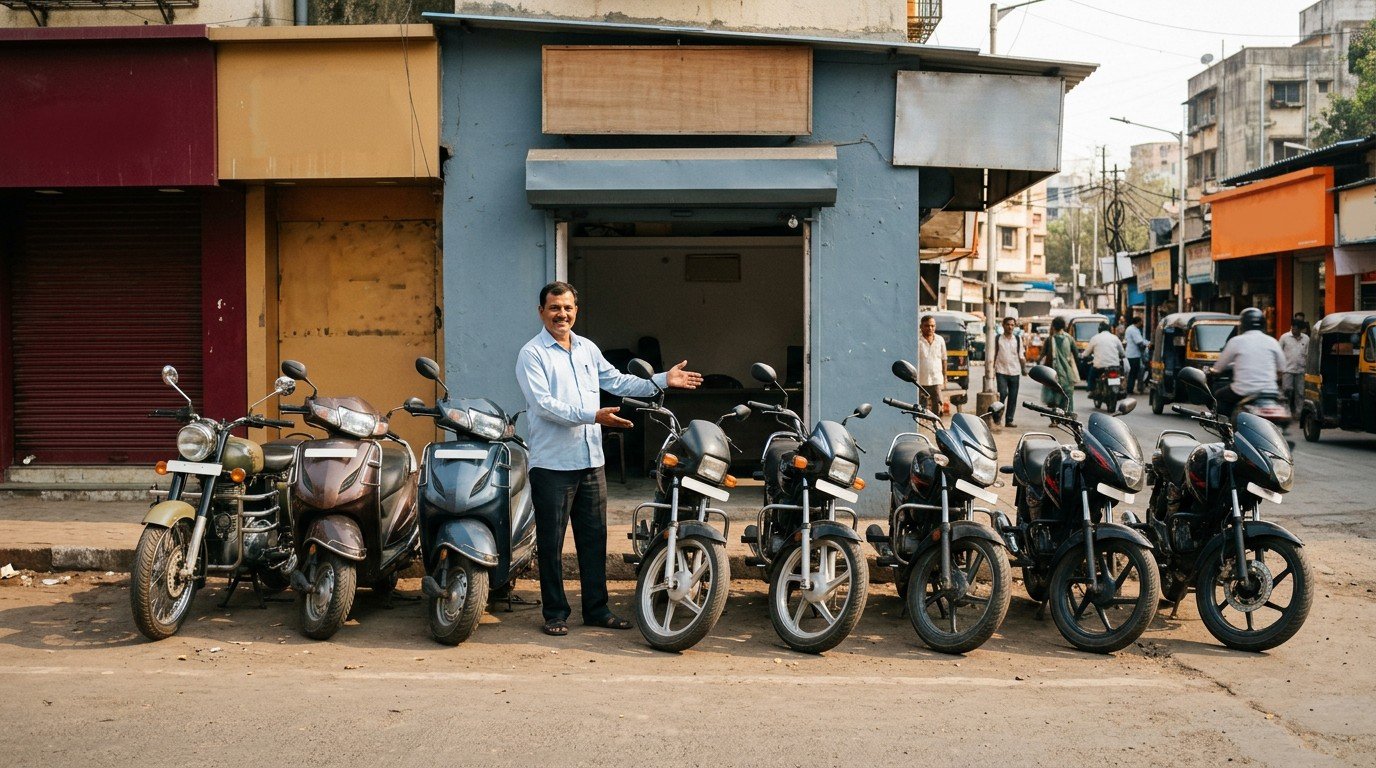
The best second hand bikes pass four tests: the model is common enough that every mechanic in Virar stocks its parts, it is still in production, its engine is simple with a long service interval, and its insured value and resale hold up. This page runs each test with the makers’ and the regulator’s own figures.
Listen to this article, about 20 minutes. A synthetic voice reads the article and announces each section title as it begins; tables are read row by row and the questions at the end are left out.
Recorded 6 November 2026 from the article as published that day. Press a chapter to jump there; the highlighted line is what is playing. A play button sits beside every section heading, and once you scroll past this player a bar at the bottom of the screen keeps the controls in reach. Tap or click any sentence to hear the reading start from there.
On this page: September 2026 registrations by maker from FADA’s retail table, a table of seven common models with each maker’s own engine figure and service interval, the IDV depreciation schedule worked on a Rs 80,000 model, the third party premium bands by engine size, and what buyers on five threads reported.
Think you already know this? Five questions, one minute.
Every answer is on this page. Answer from what you know now; the page fills in the rest.
-
1. In FADA’s September 2026 retail table, how much of the month’s two wheeler registrations did Honda, Hero and TVS take between them?
Honda 4,68,789, Hero 4,34,280 and TVS 3,64,640 out of 17,90,188 registered, as reported by Autopunditz. Read the section
-
2. What does this page use as the check that a model is still in production?
Every model in the engine table links to the maker’s own page, such as Hero’s Splendor+ page; if the page exists on the day it is read, the bike is in production. Read the section
-
3. After the free services, how often does Honda’s page schedule paid service on the Activa 110?
Honda’s Activa 110 page lists paid service every 6,000 km or within 6 months; Hero and TVS schedule visits every 3,000 km. Read the section
-
4. Under the IDV depreciation schedule, what is taken off the listed price for a bike over 4 and up to 5 years old?
The schedule in the IRDAI hosted motor wording runs 5, 15, 20, 30, 40 and 50 per cent, and beyond 5 years the value is agreed between insurer and insured. Read the section
-
5. Which check did a rider on the June 2026 r/IndianBikes thread add that no maker’s page mentions?
The rider advised replacing tyres over five years old even with tread left, on the June 2026 tip thread. Read the section
Every list of the best used bikes on the internet is somebody’s opinion in a numbered font. This one is not a list. A bike that is a joy on a Sunday run to Lonavala is a tiresome thing to push to a mechanic in Nalasopara on a Monday morning, so instead of a ranking you get four things to check about any model before you go and see it. Bike, here as everywhere on this site, means a motorcycle or a scooter. The section on E20 petrol and older bikes was added on 27 October 2026.
Why is the commonest bike usually the best used bike?
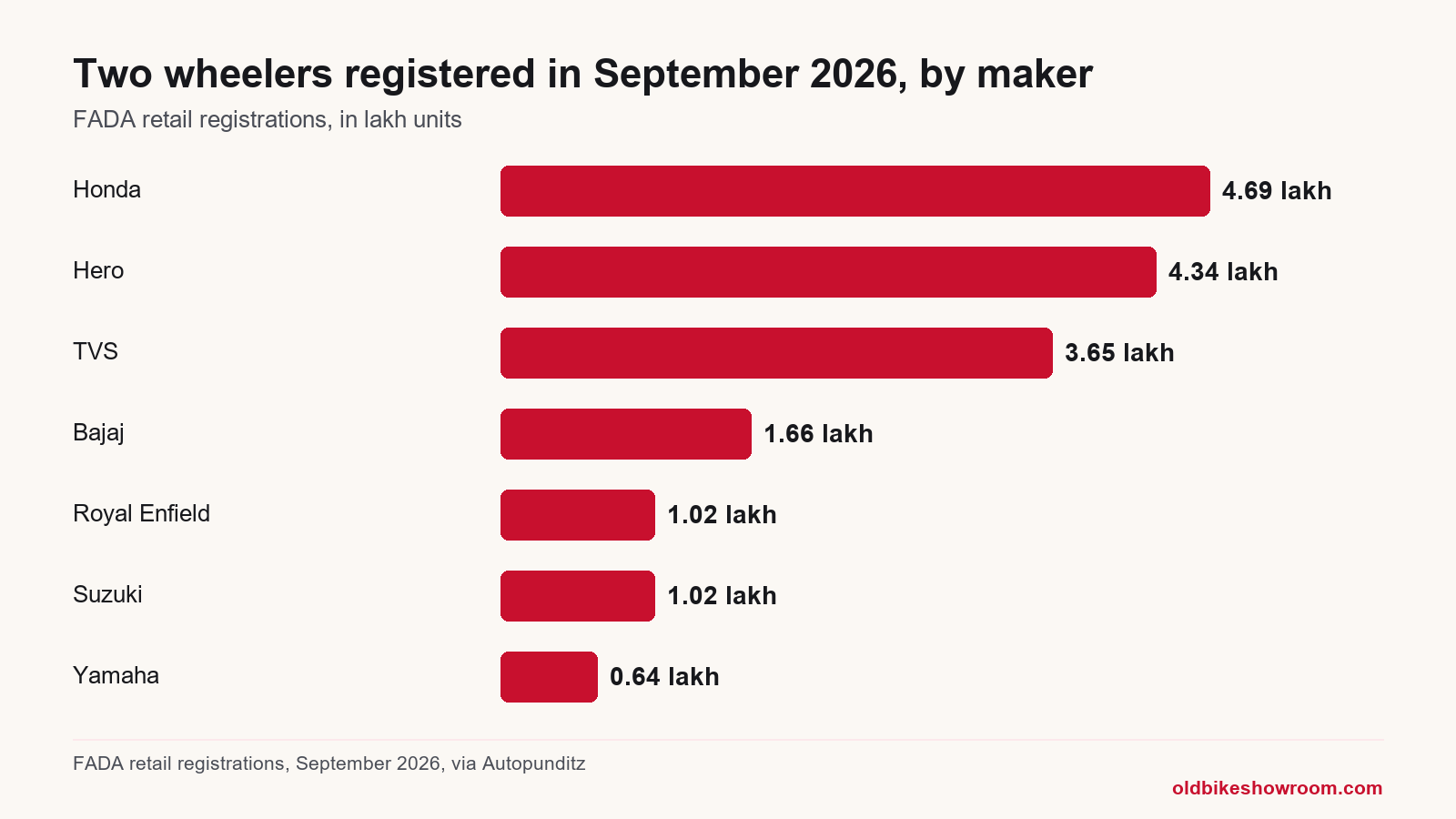
Because the commonest bike has the commonest parts, and parts are what keep a used bike cheap to own. The dealers’ body FADA publishes retail registrations every month, and the September 2026 table reported by Autopunditz puts Honda at 4,68,789 two wheelers, Hero at 4,34,280 and TVS at 3,64,640, out of 17,90,188 registered in the month. Three makers took 71 per cent of everything registered in India. Bajaj followed with 1,66,112, Royal Enfield with 1,02,226 and Suzuki with 1,01,926. Dispatches tell a slightly different story: Autocar India reported Hero shipping 7,66,348 units to dealers in the same month, ahead of Honda’s 7,06,266, and the two measures count different things, what left the factory and what reached a number plate.
Model by model figures are not published by FADA or the makers, so the maker is the best public measure of how common a bike is. Commonness buys you a mechanic who has seen the fault before, a spares shop with the part on the shelf, and a used price that is easy to check because fifty similar bikes are for sale within ten kilometres.
The opposite case is instructive. A rider on r/mumbai with a 2011 Honda CBR 250R, a model Honda no longer sells here, spent from April to August 2026 looking for a front tyre in the stock size, trying shops across both suburban lines, Dadar, Parel and Lamington Road, then Pune, before finding one. Nothing was wrong with the bike. It was simply rare, and rare is expensive in a way no price tag shows.
Is the model still in production?
A model that is on its maker’s Indian website today has parts in the pipeline, a service schedule that dealers still follow, and a price that resale can be measured against. Every model in the table below links to the maker’s own page, which is the whole check: if the page exists, the bike is in production as of the date we read it.
A model that has gone out of production is not automatically a bad buy, but the clock on its parts has started. On a June 2026 r/IndianBikes thread asking for one tip on buying second hand, a member who had bought an old Bullet, a version they said went out of production in 2010, was advised to sell it and buy a cheaper scooter, and admitted they did not know how the engine would take to today’s petrol. On a September 2026 thread about a 2024 BSA 650 offered at Rs 2.8 lakh with 5,000 km, the first reply was that the writer had never seen one on the road, and the last ten comments argued about whether the engine was built for E20 fuel. Neither thread settled it, which is the point: on a rare model you are the one doing the research. What the makers themselves say about E20 is set out in the E20 section below.
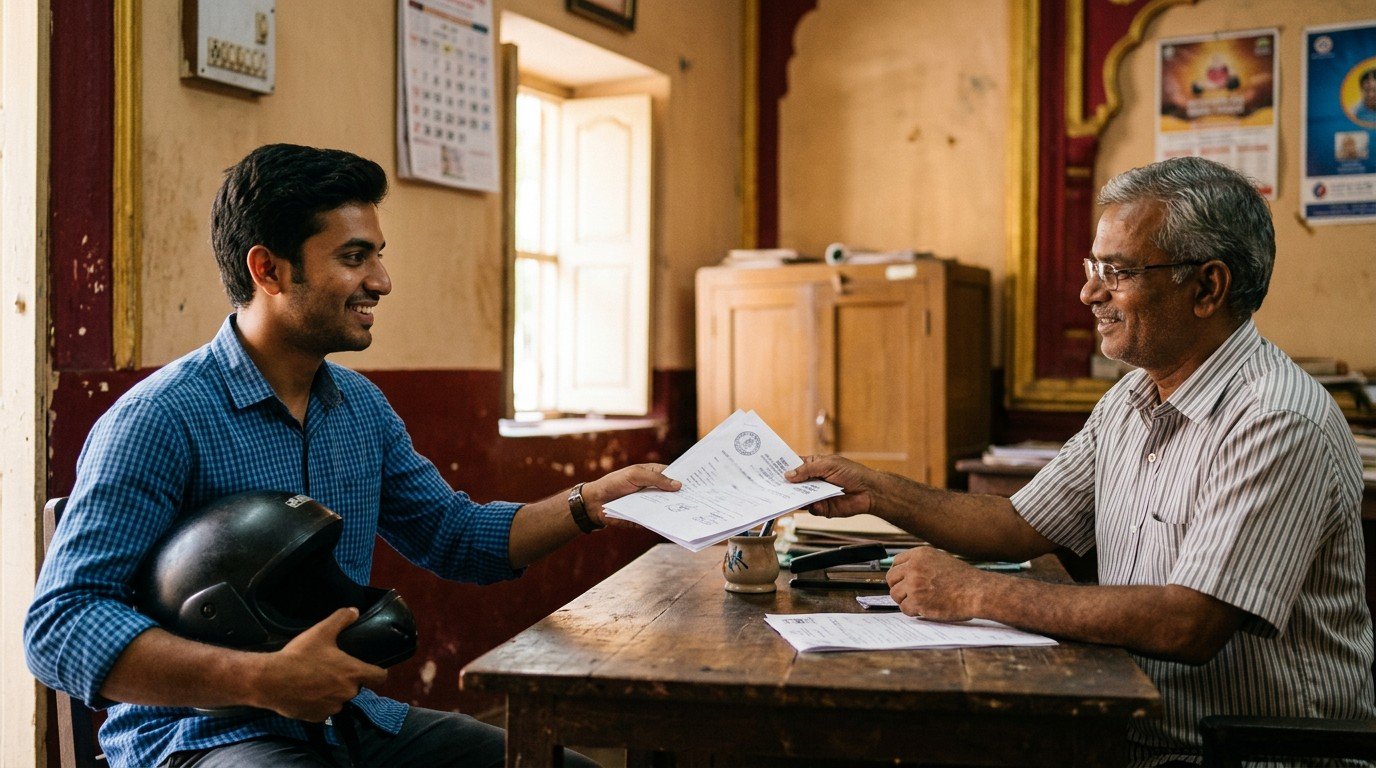
The paperwork does not care how common the model is. Section 50 of the Motor Vehicles Act, 1988 gives the seller fourteen days and the buyer thirty to report the transfer, on a Splendor or a BSA alike. The shop keeps the document list on its RC transfer documents page, and our guide to the papers, deadlines and forms when you buy a second hand bike walks through the order.
Which engines are simplest to keep running?

Single cylinder, air cooled, fuel injected, with a service due every 3,000 to 6,000 kilometres. That describes almost every bike in the table below, and it is not an accident. An air cooled engine has no radiator, no coolant, no water pump and no hoses to perish, so at ten years old there is simply less to go wrong. Liquid cooling is the right engineering for a fast bike that runs hot; on a commuter it is extra plumbing. The table carries each maker’s own figures, read on 11 October 2026, with the service interval after the free services run out. Where a maker does not publish a figure we say so rather than guess. What those intervals, the free services and the petrol add up to each month is worked out in our note on what a cheap commuter costs to run at Rs 111.21 a litre.
| Model | Engine, as the maker lists it | Service after the free ones | Maker’s page |
|---|---|---|---|
| Hero Splendor Plus | 97.2 cc, air cooled, single cylinder OHC | Hero’s schedule runs in 3,000 km steps; the manual puts the oil change at 6,000 km | Splendor+ page, service schedule |
| Honda Activa 110 | 109.51 cc; the page does not state the cooling | Every 6,000 km or within 6 months; warranty 3 years or 36,000 km | Activa 110 page |
| Honda Shine 125 | 123.94 cc, PGM-FI; the page does not state the cooling | Every 6,000 km or within 6 months; warranty 3 years or 42,000 km | Shine 125 page |
| TVS Jupiter 110 | 113.3 cc single cylinder, fuel injected | Every 3,000 km after the free services; spark plug and air cleaner at 12,000 km | Jupiter page, maintenance schedule |
| Bajaj Pulsar 150 | 149.5 cc, naturally air cooled, Bosch FI | Every 5,000 km or 120 days; oil change every 10,000 km | owner’s manual |
| Suzuki Access 125 | 124 cc, air cooled, SOHC 2 valve | No model schedule found on Suzuki’s site; its general guide says 5,000 km or 6 months | Access 125 page, service guide |
| Royal Enfield Classic 350 | 349 cc, air-oil cooled, single cylinder | Royal Enfield gives 6 months or 5,000 km for the Goan Classic 350, which shares the engine; oil at 12 months or 10,000 km | Classic 350 specification, Goan Classic 350 page |
Two things stand out. Honda’s scooters and commuters go the longest between paid services, at 6,000 km, while Hero and TVS schedule visits every 3,000 km, so a bike doing 40 km a day sees a Hero or TVS workshop about every ten weeks and a Honda one about every five months. And every figure in the table assumes a bike serviced on time. The service book tells you whether the one in front of you was; how to read it, and the bike, is in our guide to what to check on second hand bikes before you pay. A dealer who calls a bike refurbished should be able to show the same history in invoices, and our guide to what the word refurbished does and does not promise lists the papers to ask for.
Will an older used bike run on E20 petrol?
Yes, in almost every case, but what it may need depends on the year it was built, and the manufacturing date on the RC tells you which side of the line a bike sits. This matters for every used bike, not just rare ones, because there is no other petrol to buy. The petroleum ministry’s ethanol FAQ of 10 July 2026 puts national blending at 20 percent for November 2025 to June 2026, up from 12.1 percent in 2022-23, and explains why pumps will not stock E0, E10 and E20 side by side. The owner’s manual in the glovebox may say E10. The pump does not read manuals.
The ministry’s own position has two parts. Its release of 12 August 2025 says that “only in case of certain older vehicles, some rubber parts and gaskets may require replacement earlier”, and calls that replacement inexpensive work for routine servicing, perhaps once in a vehicle’s life. The July 2026 FAQ adds that “some vehicles may experience a 3 to 5 percent reduction in fuel economy”. Notice what both documents lean on: the evidence on older vehicles in the FAQ is Maruti Suzuki’s servicing of 2.84 crore cars in 2025-26. Neither gives a single figure for two wheelers, so for bikes the makers’ word is what there is.
| Maker | What it says about E20 | Older bikes | Source |
|---|---|---|---|
| Hero MotoCorp | Building E20 compliant bikes since April 2023 | BS3 and BS4 bikes made before 2023 may see a “marginal impact on fuel efficiency” | Autocar India, 13 September 2025 |
| Honda | Every two wheeler made in India from April 2025 is E20 ready | Older models are material compatible, with possibly “some effect on performance parameters” | Autocar India, 13 September 2025 |
| TVS | E20 material compliant since 2023 | Nothing stated for bikes made before 2023 | Autocar India, 13 September 2025 |
| Bajaj | All motorcycles made in the last 10 years are E20 compatible, with no new parts needed | Warranty applies on E20; a “slight loss in fuel efficiency” is possible | Rushlane, 14 July 2026 |
| Royal Enfield | The whole range compliant since BS6 came in on 1 April 2020 | A kit of O rings, tubes and seals for carburetted BS3 and BS4 350s (Classic, Bullet, Thunderbird), reported at Rs 1,700 for BS4; no kit for the 500s | Autocar India, BikeAdvice, 23 February 2026 |
Read against the RC, that table sorts most used bikes into three groups. A bike made from April 2023 onwards was built for E20 on Hero’s, TVS’s, Bajaj’s and Royal Enfield’s own statements; Honda dates full E20 readiness from April 2025 and calls its earlier bikes material compatible. A BS6 bike made between April 2020 and March 2023 is covered by Royal Enfield’s and Bajaj’s statements and, more loosely, by Honda’s material compatible line; for a Hero or TVS from those years the makers say less, so ask their service centre about that model. A BS4 or older bike, made before April 2020 and often carburetted, is most likely what the ministry means by “certain older vehicles”, though it never says which years. That is no reason to walk away from a good one. It is a reason to ask whether the fuel hoses and carburettor seals have been replaced, and on a Royal Enfield 350 whether the kit has gone in.
On the test ride, a carburetted bike that starts hard from cold, hunts at idle or smells of petrol around the carburettor is telling you something, and a wet patch or a crack on the fuel hose says the same thing more plainly. Autocar India also flags rust inside the tank on older bikes, so open the cap and look. Mileage claims need the same care: Autocar puts reported drops at 3 to 20 percent depending on age and riding, against the ministry’s 3 to 5, and no maker publishes a two wheeler figure. On warranty, Autocar reports that the makers’ body SIAM said warranties on older vehicles would be honoured on E20 “irrespective of what the user manual says”, though on most used bikes that warranty ran out years ago.
How do insurance and resale behave on a used bike?
Insurance is the one place where a used bike’s value is written down by rule. The schedule in the private motor wording hosted by IRDAI fixes the Insured’s Declared Value by age, starting from the model’s listed selling price today:
| Age of the bike | Depreciation for fixing IDV | What a Rs 80,000 model is insured for |
|---|---|---|
| Not exceeding 6 months | 5 per cent | Rs 76,000 |
| Over 6 months, up to 1 year | 15 per cent | Rs 68,000 |
| Over 1 year, up to 2 years | 20 per cent | Rs 64,000 |
| Over 2 years, up to 3 years | 30 per cent | Rs 56,000 |
| Over 3 years, up to 4 years | 40 per cent | Rs 48,000 |
| Over 4 years, up to 5 years | 50 per cent | Rs 40,000 |
| Beyond 5 years | Agreed between insurer and insured | Whatever the two agree |
The Rs 80,000 column is our arithmetic on the schedule, not a price for any bike, and the wording says the schedule applies to total loss claims. Still, it is the only age based value that exists for every bike in India, and a used bike asking far above the IDV for its age needs a reason. Our guide to a fair second hand bike price works the sum in full.
The other insurance number follows the engine, not the bike. Third party premium is set by the central government in bands of engine capacity, and the current figures come from the Motor Vehicles (Third Party Insurance Base Premium and Liability) Rules, 2022, notified on 25 May 2022 and in force from 1 June 2022. As SCC Online summarised the final rules, a two wheeler pays Rs 538 a year up to 75 cc, Rs 1,366 from 150 to 350 cc and Rs 2,804 above 350 cc. The 75 to 150 cc band, where most commuters sit, is given as Rs 714 in one insurer’s guide, which we could not match to the gazette text, so take that one as reported. The only later amendment we found, the notification of 5 January 2024, changed rates for another category of vehicle, not two wheelers, and on 27 October 2026 we found no newer two wheeler schedule. The direction is not in doubt: a 350 costs about twice as much as a 150 to insure against third parties every year, before any own damage cover.
Resale has no public schedule. What the accounts below suggest is that common models shed value slowly and rare ones shed it fast, which is the first test again, seen from the selling end.
What do people who bought second hand actually report?
We read four r/IndianBikes threads from April to September 2026 and one r/mumbai thread, about 85 comments in all. These are what people report, not findings, and the figures are theirs.
On the June 2026 tip thread, the most upvoted advice was to ride the bike for at least thirty minutes in traffic and on the highway, to warm it up and then watch for blue or white smoke at high revs, and to treat high kilometres as a good sign because it means the bike rides well, while a bike with 5,000 km in two years had probably been standing and the reason needed finding. One rider added a check no maker’s page mentions: tyre manufacturing dates, with anything over five years old replaced even with tread left.
A member on an April 2026 thread bought a 2022 model with 32,000 km for Rs 1.45 lakh after finding a new one would cost Rs 3 lakh on finance, and got the papers transferred through a mechanic who knew the seller. A reply called 32,000 km in four years reasonable and said the scary ones were dealer bikes seven or eight years old showing 5,000 to 15,000 km.
On a September 2026 thread, a first time buyer was offered a 2024 Royal Enfield Hunter 350 with 21,000 km for Rs 1.34 lakh through an online platform. The replies split: one said never to buy a used Royal Enfield, an owner of the same model said a new one had cost them Rs 2.25 lakh all in, and a third described buying a used Honda CB250R for Rs 1.1 lakh, spending nothing on it for a year, and selling it for Rs 95,000.
The BSA thread and the Mumbai tyre thread are the ones that cut against a simple story. Both bikes were sound. Both were rare. One buyer could not find a straight answer on fuel, the other spent four months finding a tyre. Set against the makers’ pages, the accounts agree on the service interval and go further on three things no official page says: take a mechanic, read the tyre dates, and judge kilometres against age rather than on their own. If reading tyre dates is new to you, our guide to MRF tube and tyre prices and the sidewall markings shows where the production week sits.
So which second hand bikes should you look at?
The ones that pass all four tests for the riding you actually do. For a daily run under 15 km with a pillion and shopping, a 110 cc scooter from one of the big three makers passes every test with room to spare. For 15 to 40 km a day, a 125 scooter or a 100 to 125 cc commuter motorcycle does it on less fuel. For highway runs to Palghar or Mumbai, a 150 cc commuter is the first size that holds speed with two on board. A 350 is a weekend bike with a weekday insurance bill, and the first test still applies: the Classic 350 is common, the imported alternatives are not. Electric scooters have their own tests, covered in our guide to used electric bikes.
Use the chooser below to turn your distance, your experience and your budget into the kind of bike to look at, then look at what is in stock today on the Old Bike Showroom bikes page, where every bike has already been through the paper checks. Or come to the showroom at Bolinj Naka, Agashi Road, Virar West, and call 070665 57209 first so we know you are coming.
Which kind of used bike fits your riding?
Three questions, one kind of bike to look at. It never names a model: the four tests on this page do that job, one bike at a time.
Worked in your browser, nothing is stored or sent. The service intervals are the makers’ figures from the table above and the premium bands are the reported third party rates; both are estimates until you see the bike and the policy.
Frequently asked questions
Is a used scooter or a used motorcycle the better buy?
For short runs with a pillion and luggage, a scooter; for daily distances over 15 km, a geared commuter usually gives better fuel economy and a longer service interval. Both pass the same four tests.
How many kilometres is too many on a used bike?
There is no fixed number. Judge the reading against the age and the service book: 8,000 to 10,000 km a year with services on time is normal use, and a very low reading on an old bike needs explaining.
Does a bigger engine cost more to insure?
Yes. Third party premium is set by engine capacity, and the band above 350 cc is reported at about four times the band under 150 cc. Own damage cover is priced on the IDV, which depends on the model’s price.
Is a bike older than ten years worth buying?
It can be, if parts are still easy to get and the RC is valid. The IDV schedule stops at five years, after which the insured value is agreed case by case, so get an insurer’s quote before you agree a price.
Is a liquid cooled bike a bad used buy?
Not bad, but more to check: the coolant level and colour, the radiator fins, and any crust around the hoses and pump. On a commuter the simpler air cooled engine has fewer parts to fail.
Does the service book matter if the bike runs fine?
Yes. The makers’ intervals in the table assume services on time, and the warranties they quote are void without them. A clean book is also the quickest proof the odometer has not been touched.
Finished the page? The same five questions from the top, to see what stuck.
RTO rules, fees and insurance terms change. This page was checked against the sources linked above on the date shown. Questions about a bike? Old Bike Showroom, Bolinj Naka, Virar West.
Leave a Reply