
Used electric bikes are worth buying when three things check out: the battery’s state of health on paper from an authorised service centre, a battery warranty that the maker’s own terms let pass to you, and an RC, unless the model is a certified low speed scooter. Most of the money is in the battery, so the checking goes there.
Listen to this article, about 17 minutes. A synthetic voice reads the article and announces each section title as it begins; tables are read row by row and the questions at the end are left out.
Recorded 26 October 2026 from the article as published that day. Press a chapter to jump there; the highlighted line is what is playing. A play button sits beside every section heading, and once you scroll past this player a bar at the bottom of the screen keeps the controls in reach. Tap or click any sentence to hear the reading start from there.
On this page: the low speed exemption quoted from rule 2(u), four makers’ battery warranty transfer terms side by side from their own pages, what an electric scooter costs to transfer in Maharashtra, and five owners’ accounts from a Team-BHP thread.
Think you already know this? Five questions, one minute.
Every answer is on this page. Answer from what you know now; the page fills in the rest.
-
1. Under the rule 2(u) proviso, what top speed must a two wheeled battery vehicle stay under to escape registration?
It must also have a motor under 0.25 kW over thirty minutes and be verified by a testing agency. CMVR rule 2(u) proviso Read the section
-
2. What do Ola Electric’s battery warranty terms say about a second owner?
The terms call it transferable to the subsequent owner for the remaining period, applicable only in India. Ola battery warranty terms Read the section
-
3. Which check does this page put first?
Owners on the thread note that the apps show charge and estimated range but not true battery health. Team-BHP thread Read the section
-
4. According to Ather’s ownership transfer FAQ, does moving the app to the buyer complete the transfer?
The app moves the digital controls and subscriptions; the legal RC transfer still goes through the RTO or Parivahan. Ather ownership transfer FAQ Read the section
-
5. Which fees did the 2 August 2021 notification exempt battery operated vehicles from?
The exemption names issue, renewal and a new registration mark, not transfer. PIB release, 3 August 2021 Read the section
A word on the word. Here, as everywhere on this site, an electric bike means an electric scooter or motorcycle, the kind with a number plate, not the pedal kind. Buying one second hand is mostly like buying any used two wheeler, with one large exception under the floorboard. A petrol engine complains through smoke and noise. A lithium battery says nothing, politely, until the range is gone. Everything below was checked against the makers’ and the government’s own pages on 10 October 2026, and the battery safety rules section was added on 26 October 2026.
Does a used electric scooter need an RC at all?
Almost always, yes. Only one narrow class of electric two wheeler escapes registration. The proviso to rule 2(u) of the Central Motor Vehicles Rules, in the 2014 amendment text, says a two wheeled battery operated vehicle “shall not be deemed to be a motor vehicle” only if a testing agency has verified all of these: a motor with thirty minute power less than 0.25 kW, a top speed less than 25 km/hr, suitable brakes with a white reflector in front and a red one behind, and an unladen weight, without the battery, of no more than 60 kg.
| Question | Certified low speed scooter | Registered electric scooter or motorcycle |
|---|---|---|
| Top speed | Less than 25 km/hr | Above that |
| Motor power | Less than 0.25 kW over thirty minutes | Above that |
| RC, number plate, insurance | Not required, since it is not a motor vehicle | Required, same as petrol |
| RC transfer when sold | Nothing to transfer | Forms 29 and 30, as for any bike |
| Source | CMVR rule 2(u) proviso | Motor Vehicles Act, 1988 |
This is where the used market gets slippery. In October 2022 the road transport ministry asked states to act against dealers selling scooters as low speed models that actually ran at 40 to 55 km/h without type approval or insurance. A second hand “no RC needed” scooter that comfortably outruns a bus is, legally, an unregistered motor vehicle, and riding it without registration and insurance is an offence. If it has no RC, ask for the testing agency’s certificate and check the top speed yourself.
The rule may move: TeamLease RegTech reports a draft of 21 August 2026 raising the power limit to 0.6 kW. We found no final notification on 10 October 2026, so 0.25 kW is still the rule.
Does the battery warranty pass to the second owner?
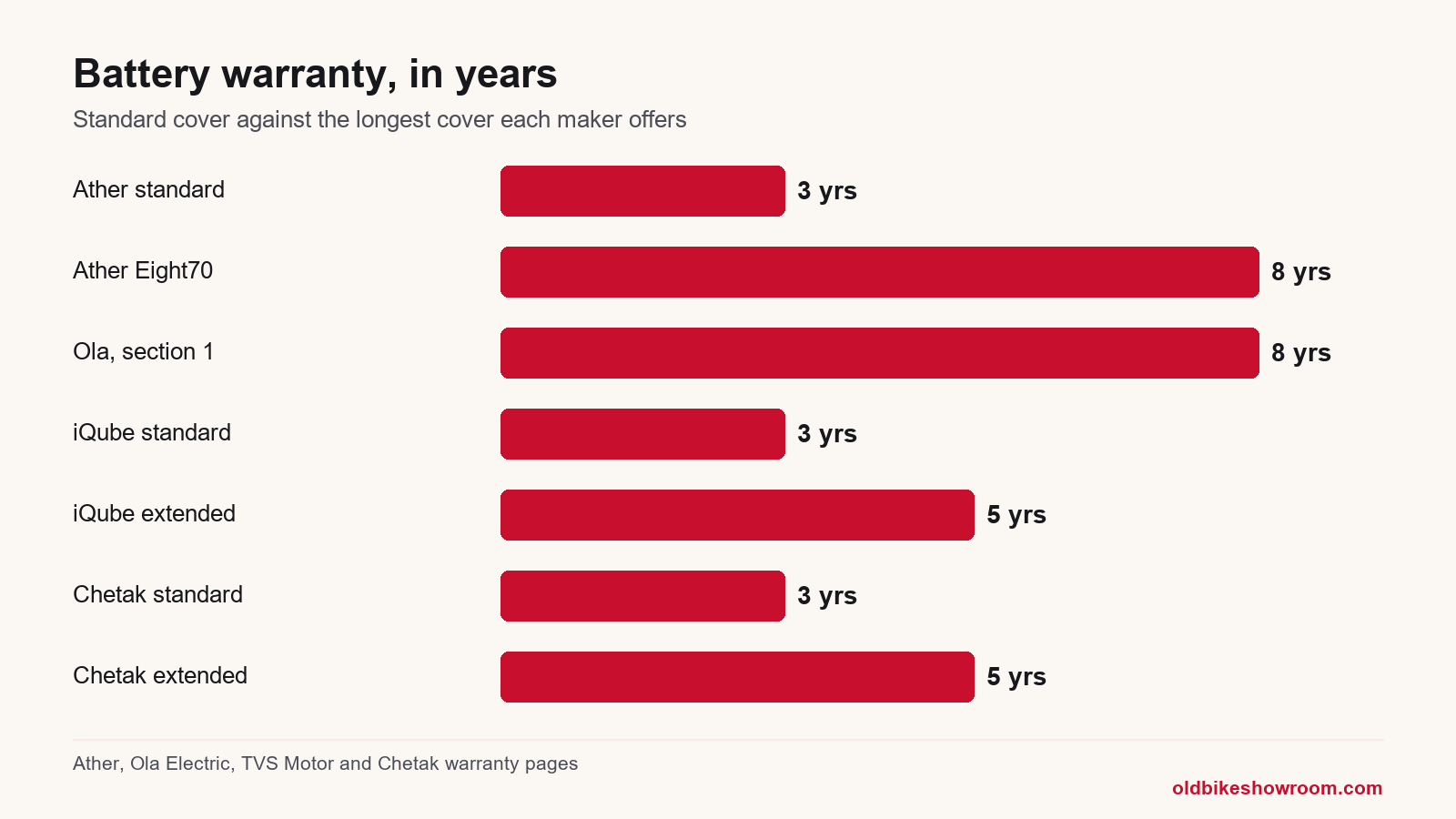
It depends on the maker, and the makers write it very differently. Here is what each one’s own page says, read on 10 October 2026. The base battery cover on all four is three years; the long numbers are optional extensions that the first owner had to buy.
| Maker | Standard battery cover | Longest cover offered | Does it pass to the next owner? | Source |
|---|---|---|---|---|
| Ather | 3 years or 30,000 km | 8 years or 80,000 km with Eight70 | Yes: the FAQ says the policy “will be transferred to the new owner” | Ather spec sheet, Ather FAQ |
| Ola Electric | 3 years or 50,000 km at the top of the page | 96 months or 80,000 km in section 1 | Yes: “transferable to the subsequent owner for the remaining warranty period” | Ola battery warranty terms |
| TVS iQube | 3 years or 50,000 km, vehicle and battery | 5 years with the extended pack | The extended pack can move: the dealer shares the policy and the RC copy in the new name | TVS warranty policy, iQube terms |
| Bajaj Chetak | 3 years or 50,000 km | Up to 2 more years with extended warranty | Not stated; the terms ask for the sale to be notified and the new owner’s KYC verified at a dealer | Chetak FAQ, Chetak terms |
Two things in that table deserve a second look. Ola’s own page disagrees with itself: its summary lists a three year, 50,000 km base plan while section 1 promises 96 months or 80,000 km, so ask the seller for the warranty certificate that came with that particular scooter. And on every brand the clock runs from the first owner’s invoice or delivery date, not from the day you buy. A 2023 scooter with a three year cover has very little warranty left to transfer.
The exclusions travel too. Ola’s terms exclude damage from leaving the battery uncharged for long periods, and modifications or repairs at unauthorised service points. A seller who fitted an aftermarket speed hack may have quietly spent your warranty for you.
How do you check the battery on a used electric bike?
Not from the dashboard. Owners on the Team-BHP thread below point out that the apps show charge and estimated range, but not the battery’s true state of health the way a phone does. So the useful checks are these, in order of how much they tell you.

First, a state of health reading from the brand’s authorised service centre, on paper, taken in the last few weeks. Ask the seller to get one; a seller with a healthy battery has every reason to. Second, the warranty certificate and the service history, because Chetak’s FAQ, for one, keeps the cover in effect only while the scooter is serviced at its own centres. Third, the battery number on the pack matching the one on the warranty papers. Fourth, a test ride long enough to watch the charge fall. A charge that drops in sudden steps, rather than steadily, is a battery to walk away from.
Low kilometres are not the reassurance they are on a petrol bike. The single owner, ladies driven, garage kept listing with 4,000 km on the clock may describe a scooter that sat for months, swinging between empty and full, which is exactly what lithium cells dislike. One owner’s account below makes that point with a number.
What else should you inspect before you pay?
The charger should be the original, undamaged, and should charge the scooter in front of you. Check the charging port for scorch marks or corrosion. Listen for grinding from the motor on the test ride. Match the chassis number on the frame to the RC, exactly as you would on a petrol bike; our guide to what to check on a second hand bike before you pay covers tyres, brakes and the frame. Finally, ask whether the app account, subscriptions and connected features will move to you, since Ather, for one, says in its ownership transfer FAQ that the app transfer does not replace the RTO transfer.
Inspecting a used electric scooter
Tick each one before the money moves.
This list follows rule 2(u) of the Central Motor Vehicles Rules, section 50 of the Motor Vehicles Act and the makers’ own warranty terms. Ticks are saved on this device only.
Was the scooter built before the 2022 battery safety rules?
This is the question no used listing answers, and the RC answers it for you. In 2022, after electric scooters caught fire in several cities, the road transport ministry set up an expert committee and, on its advice, tightened AIS-156, the safety standard for electric two wheelers. The ministry’s release of 1 September 2022 says the new rules cover “battery cells, BMS, on-board charger, design of battery pack” and thermal propagation leading to fire. Its release of 27 September 2022 then brought them in two phases: Phase 1 from 1 December 2022 and Phase 2 from 31 March 2023.
Here is what each phase added, read on 26 October 2026 from the text of Amendment 3 to AIS-156, matched clause by clause to the phase list in the ministry’s release.
| What the rule requires | In force from | What it means when you buy used | Clause |
|---|---|---|---|
| A microprocessor based battery management system, verified for over charge, over discharge, over temperature, overcurrent and short circuit protection | 1 December 2022 | The pack watches itself; older packs may have simpler circuits | 6.1.2.1 and 6.1.2.3 |
| An additional safety fuse or circuit breaker on top of the BMS | 1 December 2022 | A second line of defence inside the pack | Annex 8K, clause 8 |
| A traceability record of the cells, BMS and charger with serial or batch numbers, kept by the pack maker | 1 December 2022 | The battery number on the pack should trace back to the maker’s records | Annex 8K, clause 9 |
| The pack tested at full charge for water ingress to IP X7 under IEC 60529, with no fire or explosion | 31 March 2023 | Relevant in a Virar monsoon; not a reason to ride through flood water | 6.1.1 |
| A thermal propagation test, with an audio visual warning at least 5 minutes before any fire or explosion | 31 March 2023 | A newer pack must warn the rider before a single failed cell spreads | 6.11 |
| At least four temperature sensors; an alarm above 60 °C, and power to the motor cut gradually if the scooter is moving | 31 March 2023 | Ask the service centre whether the pack has ever logged an over temperature event | Annex 8K, clause 5 |
| The manufacturing month and year printed on the pack | 31 March 2023 | Compare the pack date with the RC’s manufacturing date | Annex 8K, clause 1 |
| Critical battery data logged by the BMS for at least one month, or kept on a remote server | 31 March 2023 | A service centre has recent data to read when it writes the health report | Annex 8K, clause 11 |
| Charger with earth leakage detection | 31 March 2023 | One more reason to insist on the original charger | 6.1.3 (e) |
So the date that matters is the month and year of manufacture printed on the RC, which also shows on Vahan. A scooter made after 31 March 2023 should have been built to both phases. One made between December 2022 and March 2023 should meet Phase 1. One made before December 2022 was built to the older version of the standard. Neither ministry release says older scooters must be upgraded or taken off the road, and we found nothing that requires it on 26 October 2026, so a 2021 or 2022 scooter is legal to sell, buy and ride. It simply carries less protection by design, and its price should reflect that. The standards apply when a model is type approved, so if the dates are close, ask the brand’s service centre which version that exact scooter was approved under.
The printed pack date is the most useful line in that table for a buyer. On a pack built after March 2023, a pack date years later than the scooter’s own date usually means the battery was replaced, which is good news if the replacement came from the brand with papers. A pack date that matches no paperwork at all is a question for the seller before any money moves. A scooter that has ever overheated, smelt of burning or swollen at the floorboard should not be charged indoors or bought until the brand’s service centre has checked it.
What do the RC transfer and road tax cost on an electric bike?
The transfer itself is the same as for a petrol bike. Section 50 of the Motor Vehicles Act, 1988 gives the seller 14 days to report the sale and the buyer 30 days to apply, with Forms 29 and 30. The shop keeps the full RC transfer document list on its main site, and our guide on how to buy a second hand bike with the papers right walks through each deadline. Under section 157 the insurance moves with the scooter from the date of sale, and you have 14 days to ask the insurer to change the name.
The money is where electric differs. The ministry’s notification of 2 August 2021 exempted battery operated vehicles from fees for issuing or renewing an RC and for a new registration mark. It does not mention transfer, so expect to pay the ordinary transfer fee, which Maharashtra’s registration fees page listed at Rs 150 for a motorcycle when we read it on 9 October 2026. Road tax is the other difference. Maharashtra’s Electric Vehicle Policy 2025 gives electric vehicles registered in the state during the policy a complete exemption from motor vehicle tax, and its period is reported as running to 31 March 2030. So a used electric scooter registered here has usually paid no road tax at all, and none is waiting in its price. A petrol bike is the opposite case, and the 10, 11 or 12 percent one time tax it paid when new is broken down in our guide to what Maharashtra adds on top of a new bike’s showroom price.
| Cost on transfer | Petrol scooter | Electric scooter | Source |
|---|---|---|---|
| Transfer fee | Rs 150 for a motorcycle | Same; the exemption names issue and renewal only | Maharashtra fees, PIB, 3 August 2021 |
| Road tax already paid | One time tax at first registration | Usually none, under the state EV policy | Maharashtra EV Policy 2025 |
| Insurance | Moves with the bike; 14 days to change the name | Same | Section 157 |
Check the record before you pay. Search the registration number on Vahan for the owner’s name, any loan and the fitness and insurance dates. An electric scooter on a loan needs the lender’s NOC and Form 35, exactly as a petrol one does.
What do owners report about buying a used electric scooter?
We read fifteen posts on a Team-BHP thread about buying a used electric scooter, started on 23 April 2026, with replies running to 12 May 2026. These are what owners report, not findings, and the figures are theirs.
A member writing on 26 April 2026, who owns two electric vehicles, said they would buy second hand only with the battery’s state of health on paper. Their examples: a friend whose health reading fell 5 per cent over six months of public fast charging twice a week, and a cousin whose scooter did only 5,000 km in four years, sat unused for weeks at a time, and now reads 81 per cent.
Another member, posting the same day, bought a 2022 Ather 450+ for a family member’s college commute after waiting about four months for one inside budget. The vehicle and battery were already out of warranty, a risk they accepted because of the service network, and they noted that Ather moves the connected features only after proof of the RC transfer is shared.
A River Indie owner on 30 April 2026 suggested asking the seller to get a state of health reading at the service centre before any money moves. An iQube owner on 27 April 2026 said they were in the final third year of their warranty and after that would be on their own for a motor or battery replacement. And on 25 April 2026 another member warned that warranty carry over to a second owner is the thing to be careful with.
The accounts agree with the makers’ pages that the warranty is the asset and its clock started with someone else. They go further on one point: no maker’s page we read tells a buyer to get a state of health report, but the owners who gave advice in the thread did.
So which used electric bikes are worth a look?
The ones with paper. A scooter from a maker with a service centre near you, a state of health report, a warranty certificate with time left on it and terms that let it pass to you, and an RC. A scooter with none of those may still be cheap, but the discount has to cover a battery, and we found no replacement pack price on the makers’ pages we read, so ask a service centre for a quote before you agree a price. For how used prices are worked out generally, see our guide to a fair second hand bike price.
You can see what is in stock today, electric or petrol, on the Old Bike Showroom bikes page, which changes as bikes come and go. If you are selling an electric scooter instead, our guide on how to sell an old bike covers the seller’s side. Or come to the showroom at Bolinj Naka, Agashi Road, Virar West, and call 070665 57209 before you set out.
Frequently asked questions
Is a used electric scooter cheaper to transfer than a petrol one?
Not on the transfer fee itself, which the 2021 exemption does not cover. It is usually cheaper overall because a scooter registered under the Maharashtra EV policy paid no road tax.
Can I buy an extended battery warranty on a used scooter?
Usually not. TVS sells its pack only within 180 days of purchase, and Chetak only before the scooter is two years old and under 50,000 km. Ask the maker before you count on it.
What battery health is acceptable?
The makers do not publish a used buyer’s threshold. Ather’s Eight70 plan replaces a battery that falls below 70 per cent health inside its period, which gives a sense of where the makers draw the line.
Do I need a driving licence for a low speed electric scooter?
Not for a certified one under 25 km/hr and 0.25 kW, because it is not a motor vehicle. Any faster scooter needs a licence, an RC and insurance.
Does the warranty cover a battery that lost range from age?
Only where the terms say so. Ather’s Eight70 covers falling health; other standard warranties cover defects. Read the certificate for the scooter you are buying.
Should the seller hand over the charger?
Yes. Ask for the original charger and cable, and see it charge the scooter before you pay.
Finished the page? The same five questions from the top, to see what stuck.
RTO rules, fees and insurance terms change. This page was checked against the sources linked above on the date shown. Questions about a bike? Old Bike Showroom, Bolinj Naka, Virar West.
Leave a Reply