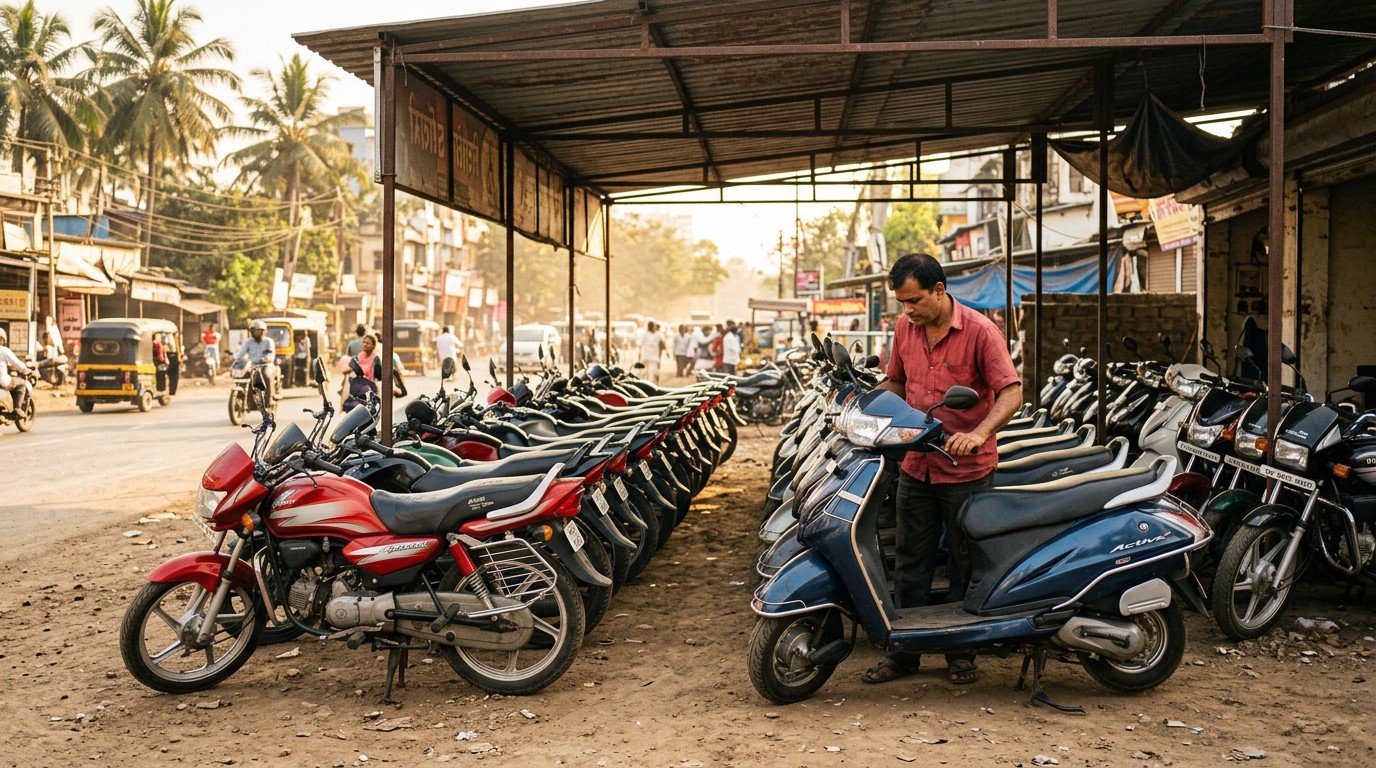
Before buying any of the second hand bikes you see, check four things in order: the papers, the chassis and engine numbers against the RC, the government’s records for loans and challans, and the bike on a cold start and a test ride. After you pay, the law gives the RC and the insurance short deadlines to change name.
Listen to this article, about 7 minutes. A synthetic voice reads the article and announces each section title as it begins; tables are read row by row and the questions at the end are left out.
Recorded 5 October 2026 from the article as published that day. Press a chapter to jump there; the highlighted line is what is playing. A play button sits beside every section heading, and once you scroll past this player a bar at the bottom of the screen keeps the controls in reach. Tap or click any sentence to hear the reading start from there.
On this page: the papers and what each proves, a five step check of the government’s own records, sections 50 and 157 of the Motor Vehicles Act quoted, and two sellers’ accounts of transfers that never happened.
Think you already know this? Five questions, one minute.
Every answer is on this page. Answer from what you know now; the page fills in the rest.
-
1. Which section of the Motor Vehicles Act makes third party insurance compulsory?
Section 146 says no one may use a motor vehicle in a public place without a policy of insurance in force. Motor Vehicles Act, 1988 Read the section
-
2. Where can you look up traffic challans against a registration number?
The government’s e-Challan portal lists challans by registration number. e-Challan Read the section
-
3. If a bike’s engine was replaced, what must be true before you buy it?
The RC records the engine number, so a replacement that never reached the RTO leaves the RC wrong. Vahan citizen services Read the section
-
4. How did one seller in the 2022 Team-BHP thread find out his old bike was still in his name?
He reported discovering it by searching the registration number on Vahan. Team-BHP, 30 May 2022 Read the section
-
5. Within how many days must the buyer apply to the insurer after the transfer?
Section 157(2) says the transferee shall apply within fourteen days from the date of transfer. Motor Vehicles Act, 1988 Read the section
Every used bike listing in Virar says single owner, well maintained, all papers clear. Some of them are even true. The checks below take about half an hour, cost nothing, and are the same ones that sort the honest listing from the one with a loan, a stack of challans or a frame number that has been filed. The legal points are quoted from the Motor Vehicles Act, 1988, read on 5 October 2026.
What papers should a second hand bike come with?
Start with the paperwork, because a perfect bike with broken papers is a bike you cannot legally own. The shop keeps the full RC transfer document list on its main site; this is what each paper proves, and when you need it.
| Paper | What it proves | When you need it |
|---|---|---|
| RC (smart card, or the RC in DigiLocker) | Who the registered owner is, plus the chassis and engine numbers | Always. No RC, no deal |
| Insurance policy | Third party cover, which section 146 of the Act makes compulsory for any bike on a public road | Always |
| PUC certificate | The bike passed its last emission check | Always |
| Forms 29 and 30, signed | The seller’s notice of transfer and the joint application to move the RC | On the day of sale |
| Lender’s NOC and Form 35 | A loan on the bike has been paid off and can be removed from the RC | When the RC shows hypothecation |
| Form 28 (NOC from the original RTO) | The original RTO has no objection to the bike moving | When the bike is registered with another RTO or state |
If the RC shows a bank or finance company as hypothecation, the bike still carries that loan until the lender issues its NOC. Do not hand over money against a promise that the NOC is coming.
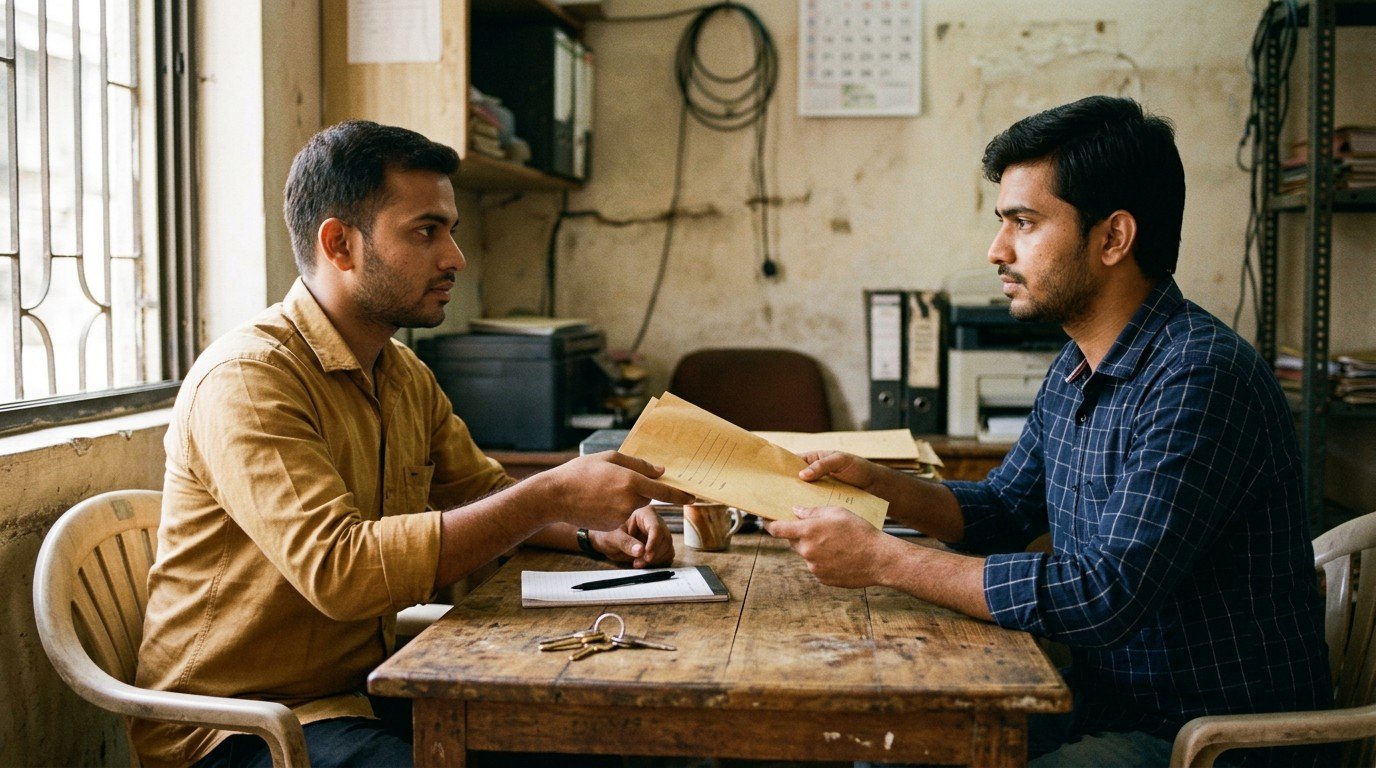
How do you check the bike’s records before paying?
Two government services let you check a bike’s record yourself before you pay, and neither depends on what the seller tells you. The Ministry of Road Transport’s Vahan citizen services (also in the mParivahan app) hold the registration record: when the bike was registered, its validity, and whether it is under hypothecation. The e-Challan portal lists traffic challans against a registration number.
- Take the registration number from the number plate and the RC, and check that they are the same.
- Look the number up on Vahan or mParivahan. The model and registration date should match the RC and the bike in front of you.
- Check whether the record shows hypothecation, and if it does, ask for the lender’s NOC before anything else.
- Search the number on e-Challan. Pending challans are commonly reported to hold up an RC transfer, so agree in writing who clears them.
- Check that the insurance and PUC dates on the papers have not already run out.
If the seller will not share the registration number before you visit, treat that as your first check failed.
How do you match the chassis and engine numbers?
The RC lists the chassis number and the engine number. Both are stamped into metal on the bike: the chassis number usually on the frame near the steering head, the engine number on the engine casing. Find both, read them in daylight, and match every character against the RC.
- Fresh paint, filing marks or uneven characters around a stamped number are a reason to walk away.
- A number plate that looks newer than the bike is worth a question, not an accusation.
- If the engine has been replaced, the new engine number has to be on the RC. An engine swap that never reached the RTO is the buyer’s problem the day the RC is transferred.
What should you look for on a cold start and a test ride?
Ask the seller not to start the bike before you arrive. A cold start tells you more than a warm one, because a tired engine often behaves only once it is hot.
- Cold start: it should catch quickly and settle into a steady idle. Blue smoke that stays is oil burning.
- Listen for knocking or a loud tapping from the top of the engine once it is running.
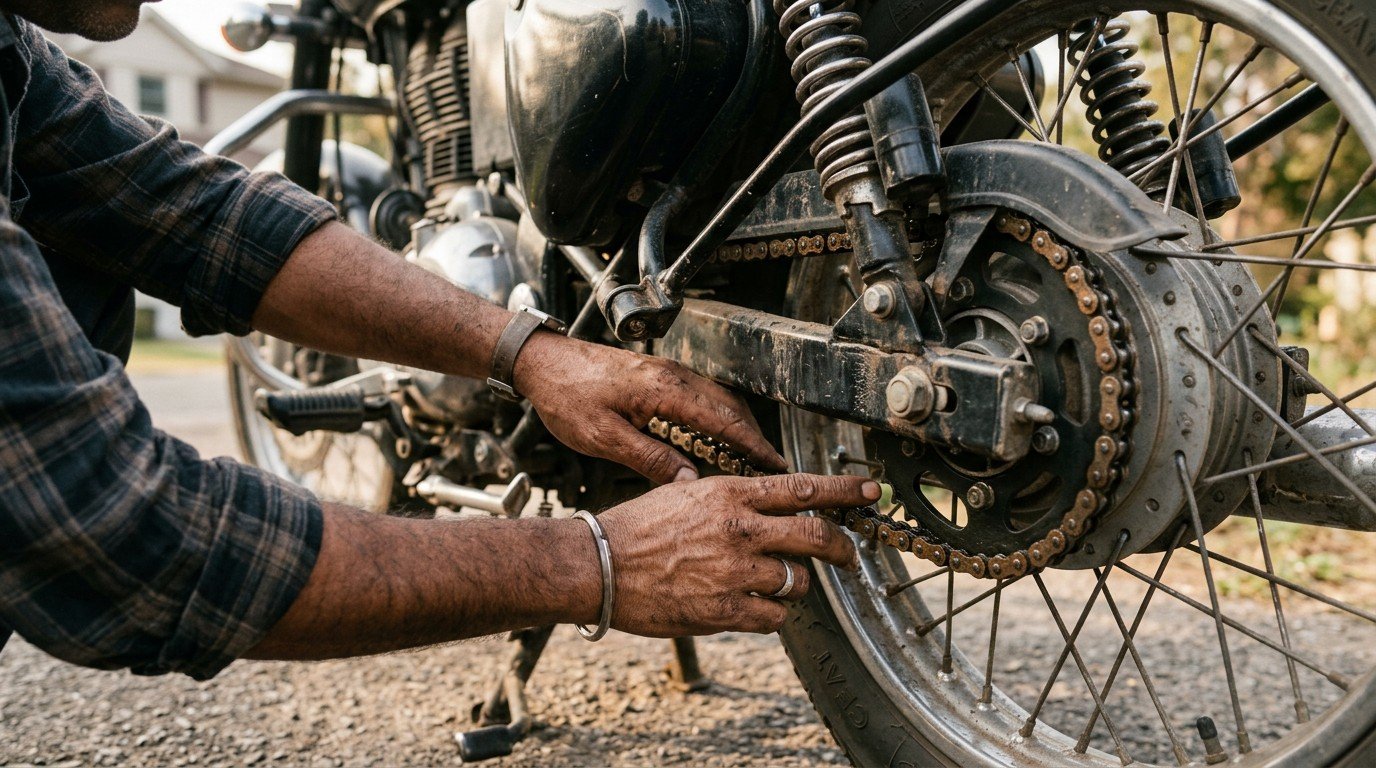
- Chain and sprockets: hooked sprocket teeth or a chain you can pull well off the rear sprocket mean a replacement soon.
- Tyres: check the tread and the sidewalls for cracks, and the date code on the tyre.
- Brakes: firm levers, no grinding, and the bike stops straight.
- Clutch and gears: it should take up smoothly and every gear should engage without a clunk or a jump out.
- Suspension: push down on the front; it should return once, not bounce, and the fork legs should not be oily.
- Electrics: headlamp, indicators, horn, brake light and the self start if the bike has one.
- The odometer: compare the reading with the wear on the footrests, grips and seat. Low kilometres on a worn bike is a story worth hearing in full.
When the bike passes, compare it with similar bikes before you agree a price. You can see what is in stock at Old Bike Showroom on the bikes page, which is updated as bikes come in and go.
Your used bike check, before you pay
Tick each check as you do it. Your browser remembers your ticks on this device.
This list follows the Motor Vehicles Act and common inspection practice. It is not a mechanic’s inspection.
What do sellers report when the transfer never happens?
The checks above protect the buyer. The transfer after the sale protects both sides, and the cost of skipping it shows up years later. On a Team-BHP thread published on 30 May 2022, one seller reported selling a bike to a used bike platform in November 2017 and finding, more than four years later, that the RC was still in his name while the bike kept collecting challans. Another member in the same thread reported that a bike he sold in 2015 was resold without any transfer, which he discovered only by searching the number on Vahan; sorting it out cost both owners trips between Pune and Mumbai.
That is two accounts from one thread, and they are what people report, not a ruling on anyone. They agree with the law on one point: the registered owner is the person the record shows, so the seller has as much reason as the buyer to see the transfer through. The second seller’s own fix is simple: he now hands over the keys only once the transfer has been started.
What has to happen after you pay?
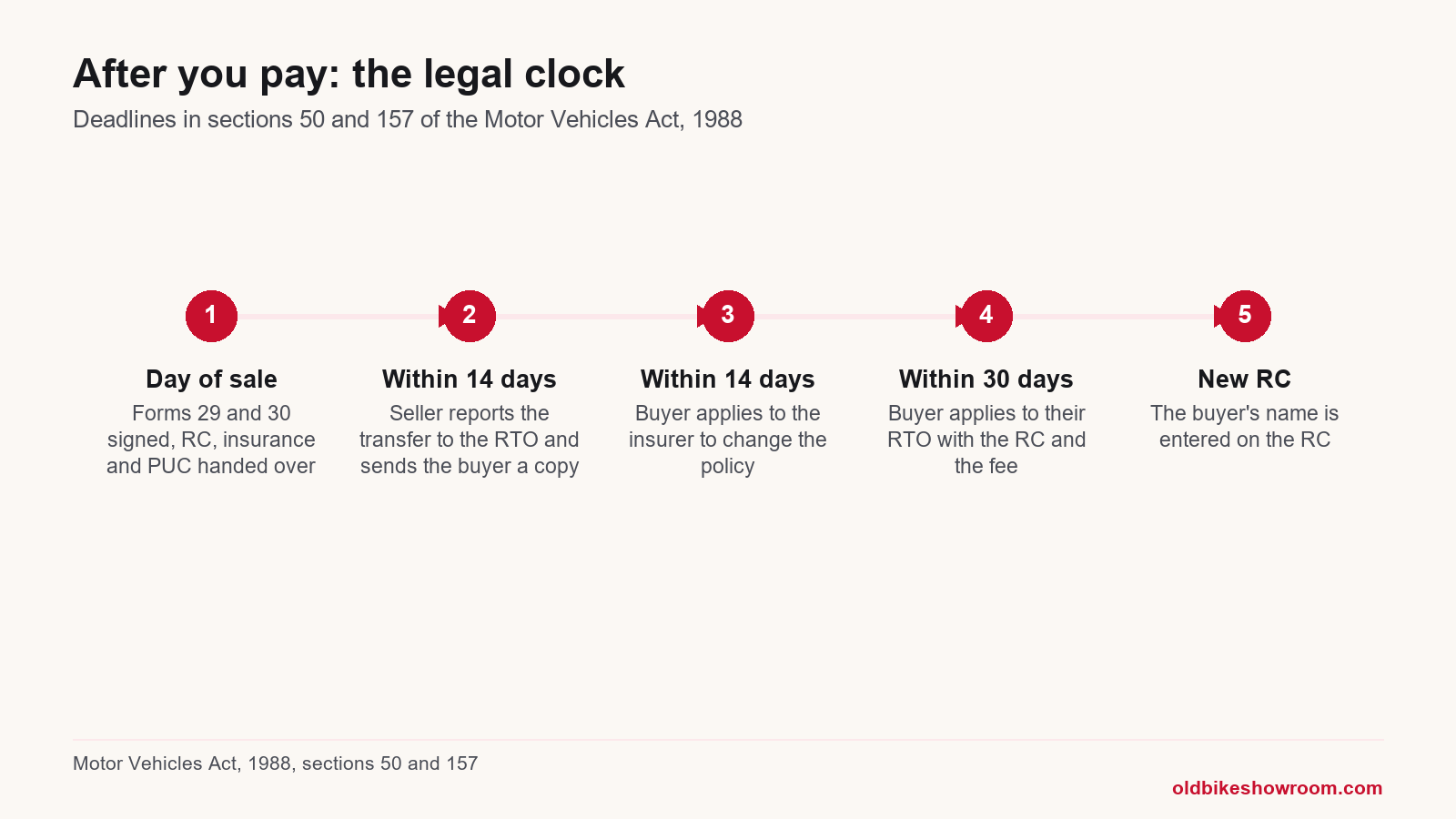
Section 50 of the Motor Vehicles Act, 1988 sets the deadlines. For a bike registered in the same state, the seller must report the transfer “within fourteen days of the transfer” to the registering authority and send a copy to the buyer. The buyer must then report it within thirty days to the RTO where they live, with the RC and the fee, so the new owner is entered on the RC.
Insurance has its own clock. Under section 157, the policy is “deemed to have been transferred” to the new owner from the date of the transfer, and the buyer “shall apply within fourteen days” to the insurer to have the certificate and the policy changed. Transfer applications are made online through Parivahan.
If you would rather look at bikes where the papers have already been through these checks, call Old Bike Showroom on 070665 57209 or visit the showroom at Bolinj Naka, Agashi Road, Virar West.
Frequently asked questions
Can I buy a second hand bike without the RC?
You should not. Without the RC, or a duplicate RC the seller has obtained from the RTO, there is no record that the seller owns the bike and no way to transfer it into your name.
How long does the seller have to report the sale?
For a bike registered in the same state, section 50 of the Motor Vehicles Act gives the seller fourteen days from the transfer to report it to the registering authority.
How long does the buyer have to apply for the RC transfer?
Thirty days from the transfer under section 50, to the RTO where the buyer lives or keeps the bike.
Does the insurance move to the new owner automatically?
Section 157 says the policy is deemed transferred from the date of transfer, but the buyer must apply to the insurer within fourteen days to have the certificate and policy changed.
What if the bike still has a loan on it?
The RC will show hypothecation. The lender’s NOC and Form 35 are needed to remove it, so ask for them before paying rather than after.
How do I check challans on a used bike?
Search the registration number on the government’s e-Challan portal and agree in writing who clears any that are pending before you pay.
Finished the page? The same five questions from the top, to see what stuck.
RTO rules, fees and insurance terms change. This page was checked against the sources linked above on the date shown. Questions about a bike? Old Bike Showroom, Bolinj Naka, Virar West.
Leave a Reply