
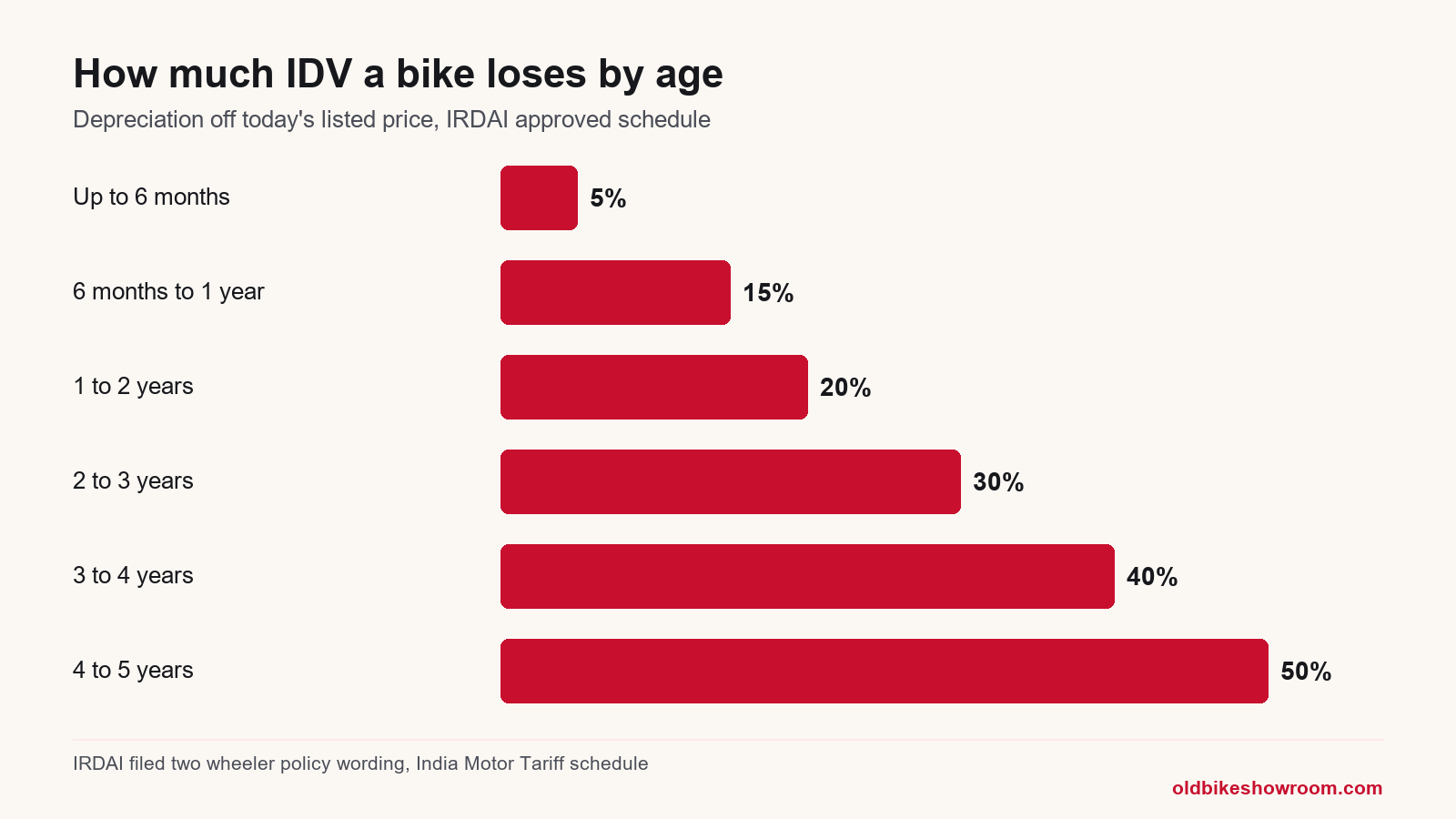
A second hand bike price starts from what the same model costs new today, minus depreciation for age. The insurance schedule IRDAI approved takes off 5 percent in the first six months and 50 percent by year five. Kilometres, condition, demand for the model and clean papers then move the real price up or down.
Listen to this article, about 16 minutes. A synthetic voice reads the article and announces each section title as it begins; tables are read row by row and the questions at the end are left out.
Recorded 3 November 2026 from the article as published that day. Press a chapter to jump there; the highlighted line is what is playing. A play button sits beside every section heading, and once you scroll past this player a bar at the bottom of the screen keeps the controls in reach. Tap or click any sentence to hear the reading start from there.
On this page: the IRDAI approved IDV depreciation schedule quoted from a filed policy wording, a worked Rs 85,000 example, the paperwork costs that cut a price, and a calculator for any model and age.
Think you already know this? Five questions, one minute.
Every answer is on this page. Answer from what you know now; the page fills in the rest.
-
1. Under the IDV schedule, how much depreciation applies to a bike between 2 and 3 years old?
The schedule sets 30 percent for a bike over 2 years and up to 3 years old. IRDAI filed two wheeler policy wording Read the section
-
2. Which price is IDV worked out from?
The wording fixes IDV on the manufacturer’s listed selling price at the start of the policy, then depreciates it. IRDAI filed two wheeler policy wording Read the section
-
3. What happens to IDV for a bike more than five years old?
Beyond five years, or for a discontinued model, the IDV is set by understanding between the insurer and the insured. IRDAI filed two wheeler policy wording Read the section
-
4. What does Maharashtra charge to transfer ownership of a motorcycle?
The state’s fee page lists transfer at 50 percent of the Rs 300 new registration fee. Maharashtra registration fees Read the section
-
5. In the July 2024 Team-BHP account, what did the pre-owned programme say its valuation counted?
The owner reported being told only the original ex-showroom price and its depreciation counted. Team-BHP, 30 July 2024 Read the section
Every used bike listing in Virar seems to have been owned by one careful person who rode it to the temple on Sundays. The price on the listing is usually a hope. There is, though, one published number that every insurer in India works from, and once you know it you can tell whether an asking price is in the right neighbourhood. Everything below was checked against the official pages on 7 October 2026, and the section on GST was added on 19 October 2026.
What decides a second hand bike price?
Six things set what a used motorcycle or scooter is worth. Only the first two can be worked out on paper; the rest you judge with your eyes, your ears and the government’s records.
| Factor | Why it moves the price | How to check it |
|---|---|---|
| Today’s ex-showroom price of the same model | Every valuation starts here, not from what the first owner paid | The manufacturer’s current price list |
| Age since first registration | The insurance schedule takes a fixed slice off for each year | Registration date on the RC or Vahan |
| Kilometres | High running means wear on the engine, clutch and chain | Odometer, read against the wear on the bike |
| Condition | A worn chain, tyres or brakes are money the buyer spends next month | A cold start and a test ride |
| Demand for the model | Popular commuters and some classics sell fast; discontinued models do not | How many similar bikes are listed and for how long |
| Papers | A loan, challans or an out of state number cost time and money to clear | Vahan, e-Challan and the RC itself |
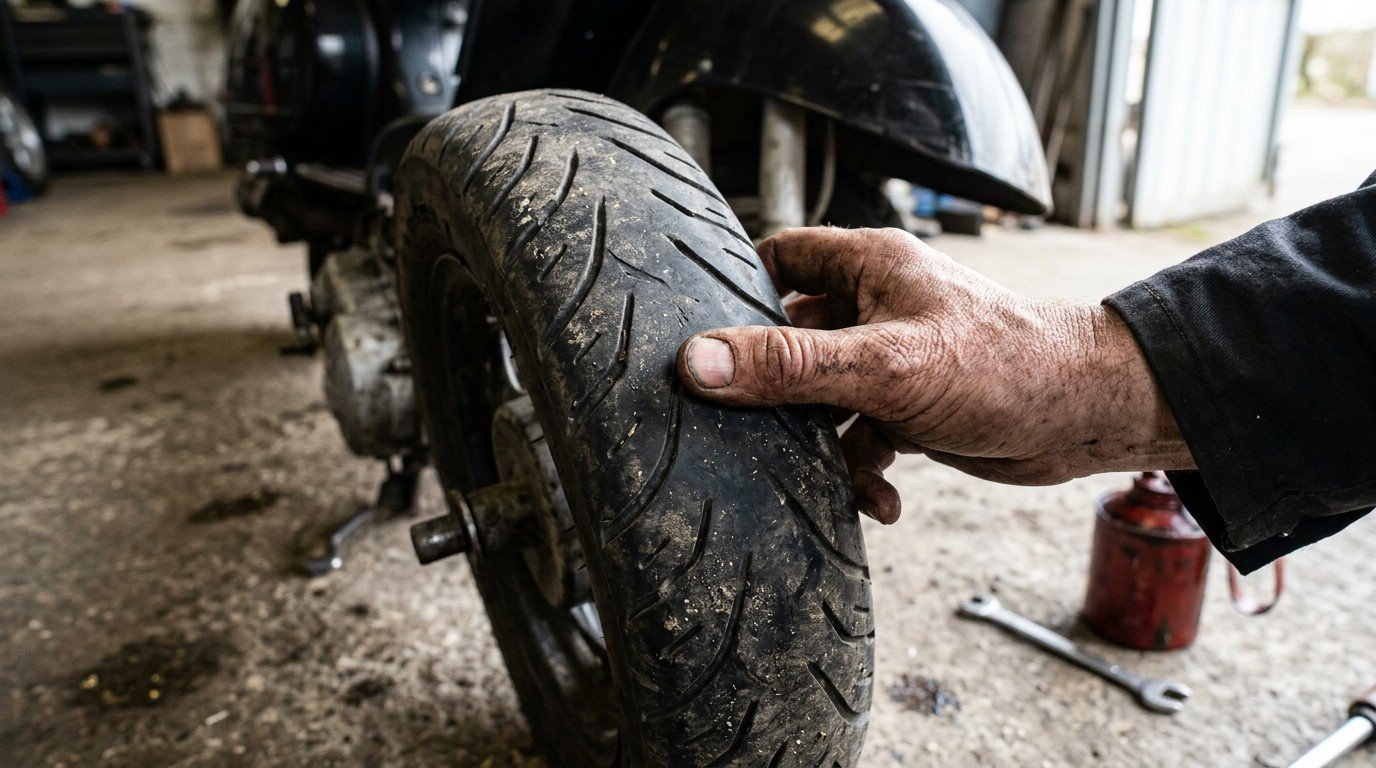
Kilometres deserve a raised eyebrow. A seven year old scooter whose odometer has never quite passed 9,000 is either a miracle or a cable that came loose. Compare the reading with the footrests, the grips and the seat before you let it move the price. A speedometer that sits at zero on the test ride points at a different culprit, and Hero’s own list prices for a speed sensor and the other bike sensors show what that repair starts at. On an electric scooter, low kilometres can even hide a tired battery, which is why our guide to buying used electric bikes puts a battery health report ahead of the odometer.
What does the IRDAI depreciation table say about a bike’s value?
The only age based value schedule that is written down for every bike in India is the one insurers use to fix the Insured’s Declared Value, or IDV. A two wheeler policy wording filed with IRDAI, read on 7 October 2026 from the regulator’s site, says the IDV is fixed on the basis of the manufacturer’s listed selling price of the same brand and model at the start of the policy, adjusted for depreciation as per this schedule:
| Age of the bike | Depreciation for fixing IDV | Value left, as a share of today’s price |
|---|---|---|
| Not exceeding 6 months | 5 percent | 95 percent |
| Over 6 months, up to 1 year | 15 percent | 85 percent |
| Over 1 year, up to 2 years | 20 percent | 80 percent |
| Over 2 years, up to 3 years | 30 percent | 70 percent |
| Over 3 years, up to 4 years | 40 percent | 60 percent |
| Over 4 years, up to 5 years | 50 percent | 50 percent |
| Over 5 years, or a discontinued model | No fixed figure | Agreed between insurer and owner |
Two details in that wording matter for anyone pricing a used bike. First, the IDV is treated as the market value for the whole policy year when a bike is stolen or written off. Second, for a bike over five years old, or a model the manufacturer has stopped making, there is no table at all: the IDV is set by agreement between the insurer and the insured. Plenty of bikes on the used market are older than that, and for a classic the agreed value matters even more, as our page on buying old vintage bikes and the 50 year rule explains.
How do you work out IDV from the ex-showroom price?
The arithmetic is short. Take the current ex-showroom price of the same model and variant, find the age band, and take off the percentage. Here is a 125cc scooter whose model lists at Rs 85,000 ex-showroom today; the figure is an example, not a bike in anyone’s stock.
| Age of the scooter | Depreciation | IDV on an Rs 85,000 listed price |
|---|---|---|
| 5 months | 5 percent | Rs 80,750 |
| 10 months | 15 percent | Rs 72,250 |
| 1 year 6 months | 20 percent | Rs 68,000 |
| 2 years 6 months | 30 percent | Rs 59,500 |
| 3 years 6 months | 40 percent | Rs 51,000 |
| 4 years 6 months | 50 percent | Rs 42,500 |
Notice the word today. The schedule works from the model’s listed price now, not the invoice the first owner kept in a plastic folder. That matters more than usual this year. As the GST Council’s FAQ on its 56th meeting sets out, the rate on two wheelers up to 350cc fell from 28 to 18 percent from 22 September 2025. If a maker passed that on in full, a model that listed at Rs 1,00,000 with 28 percent GST would list at about Rs 92,188 with 18 percent, and every IDV worked from it falls by the same 7.8 percent, however old the bike.
IDV calculator from the IRDAI approved schedule
Enter what the same model and variant lists for ex-showroom today, and the bike’s age since first registration. It applies the depreciation schedule insurers use for the Insured’s Declared Value. This is the insurance value, not a market price: kilometres, condition, demand and papers decide what a buyer will pay.
Schedule read on 7 October 2026 from a two wheeler policy wording filed with IRDAI. Beyond five years, or for a discontinued model, there is no table and the IDV is agreed with the insurer. Worked in your browser, nothing is stored or sent.
Why is the market price not the same as the IDV?
IDV is an insurance number. It answers one question: what will the insurer pay if this bike is stolen or written off this year? A market price answers a different one: what will a buyer in Virar hand over this week? The two usually sit close for a bike under five years old, and then drift apart. The written off case has a sequel, because the wreck is paid for too: our guide on whether a refurbished bike can be an insurance write-off rebuilt from salvage follows what should happen to the RC after a total loss.
| IDV | Market price | |
|---|---|---|
| Who sets it | The IRDAI approved schedule, applied by the insurer | Buyer and seller, one bike at a time |
| Starts from | Today’s listed price of the model | Whatever similar bikes are selling for nearby |
| Counts kilometres and condition | No | Yes, heavily |
| After five years | Agreed with the insurer, no table | Set by demand, sometimes above the old IDV |
| Counts road tax, insurance or accessories | No, only the listed price of the bike | Sometimes, if the buyer values them |
So use IDV as a sanity check, not a price tag. A three year old commuter asking far more than 70 percent of today’s ex-showroom price needs a reason, such as very low genuine kilometres or new tyres and a new chain. One asking far less needs a different kind of reason, and the papers are the first place to look. If you are weighing a used bike against the cheapest new commuter, our guide to the best bike in low price, new or used puts the IDV of each model beside the new on road total. Which models hold that value best comes down to how common they are, which our guide to the best second hand bikes measures with the makers’ registration figures. Whether those tyres really are new is written on them: our guide to reading the tyre sidewall and what MRF lists for bike tubes shows where to find the size and the production week.
Does a used bike price include GST?
It depends on who is selling. A bike does not pick up a fresh slab of GST every time it changes hands, which is just as well for a scooter on its fourth owner. The tax that applies to a used bike is set out in the GST Council’s release on its 55th meeting, held on 21 December 2024. It raised the rate on the sale of all old and used vehicles, including EVs, from 12 to 18 percent, and added two notes: GST applies only to the value that represents the margin of the supplier, the difference between the purchase price and the selling price, and it is not applicable in case of unregistered persons.
| Who is selling | GST on the deal | Source |
|---|---|---|
| A private owner who is not registered for GST | None | 55th GST Council release, 21 December 2024 |
| A GST registered dealer selling a used bike | 18 percent, on the dealer’s margin only | 55th GST Council release, 21 December 2024 |
| A showroom selling a new two wheeler up to 350cc | 18 percent on the full price, down from 28 percent, from 22 September 2025 | GST Council FAQ on the 56th meeting |
The margin rule makes a bigger difference than it sounds. Take a dealer who buys a scooter for Rs 40,000 and sells it for Rs 46,000; the figures are an example, not a bike in anyone’s stock. The margin is Rs 6,000, so the tax at 18 percent is Rs 1,080. Charged on the whole Rs 46,000, the same rate would have been Rs 8,280. So when a dealer’s price is higher than a private seller’s for the same model and age, GST explains only a small part of the gap; the rest is the dealer’s margin itself, and whatever checks or work went into the bike.
Two cautions. The margin treatment is for a dealer who has not claimed input tax credit on the bike, and the release states the Council’s recommendation rather than the notification itself. Tax guides report that the 18 percent rate on used vehicles was left as it was when the GST changes of 22 September 2025 took effect, but we could not find a newer official notice to confirm that when this section was added on 19 October 2026. If a dealer’s invoice shows GST, ask how it was worked out before you pay.
Which paperwork problems pull a used bike’s price down?
A bike with the right engine and the wrong paperwork is a bike you may not be able to register. Each problem below costs the buyer money or trips to the RTO, which is why it comes off the price.
| Problem | What it costs to clear | Source |
|---|---|---|
| A loan still shown on the RC | The lender’s NOC and Form 35 first; recording a loan costs Rs 500, removing it is listed as free | Maharashtra registration fees |
| Unpaid traffic challans | Whatever is pending against the number | Parivahan e-Challan |
| Ownership transfer itself | Rs 150 for a motorcycle, 50 percent of the new registration fee | Maharashtra registration fees |
| Bike over 15 years old | Rs 2,000 environment tax at each five year renewal | Maharashtra rate of vehicle tax |
| Registered in another state | Form 28 from the old RTO, then Maharashtra registration and tax | Ask your RTO for the figure |
Deadlines matter too. Section 50 of the Motor Vehicles Act, 1988 gives the seller fourteen days to report a sale within the same state and the buyer thirty days to apply for the RC transfer. A seller who cannot produce the RC, or who will not let you search the number on Vahan before you pay, has told you something about the price without saying a word. The shop keeps the full RC transfer document list on its main site.
For a bike registered outside Maharashtra, the RTO will want state tax before it registers the bike here. The amount is commonly reported to be reduced for the bike’s age, but the state’s tax page does not set out the reduction, so get the figure from the RTO before you agree a price.
What do owners report when a bike is valued for sale?
Two dated owner accounts on Team-BHP were read for this page. Two is not a survey, and they are what people report, not a finding about any company. Both are worth knowing because they show the schedule above colliding with a real sale.
In a post published on 30 July 2024, an owner who tried to sell a 2021 Royal Enfield Classic 350 through the maker’s own pre-owned programme reported a first offer of Rs 1.38 lakh. When they asked how it was reached, they were told the valuation counted only the original ex-showroom price and its depreciation, so road tax, insurance, the extended warranty and accessories added nothing. After they pushed back, a second offer of Rs 1.6 lakh came the next day, partly as an accessories voucher. They gave the bike to a friend instead.
In an account published on 14 October 2024, a rider found that a bike they had rejected at delivery in 2019 had been registered in their name anyway and sold on. The RTO would not issue an RC or a transfer until the high security plate status showed as available on Vahan, which took the manufacturer’s help and several RTO visits to fix.
Set against the official rules, the first account matches the IDV clause exactly: listed price less depreciation, nothing else counted. Where the owner and the schedule disagree is on what extras are worth. The second shows why a record problem on Vahan is a real cost, and why no buyer should take one on at the seller’s valuation.
How should a buyer and a seller use these numbers?
For a buyer, work the IDV for the model and age first, then adjust for what you found on the test ride and on Vahan. A BS4 bike that may need new fuel hoses and carburettor seals for E20 petrol is one such adjustment, and which older bikes the makers say are E20 ready helps you tell whether that applies. Our guide on what to check before you pay for a second hand bike walks through that inspection in order. If you are weighing a used bike against a new one, the guide to what goes into an on road bike price shows the road tax and fees a used Maharashtra bike has already paid.
For a seller, the same sum tells you where a fair opening figure sits. Kilometres, condition and clean papers are what lift a bike above it. Once a price is agreed, our guide to what a seller must do after the sale, from Form 29 to safe payment covers the part that starts after the handshake. If you are selling in Virar or Vasai, you can tell us about your bike on the sell your bike page, and if you are buying, the motorcycles and scooters in stock are on the bikes page. Either way you are welcome at the showroom at Bolinj Naka, Agashi Road, Virar West, or call 070665 57209 before you come.
Frequently asked questions
Is the IDV the price I should sell my bike for?
No. IDV is the insured value used for theft and total loss claims. It is a useful reference for a bike under five years old, but kilometres, condition, demand and papers decide what a buyer will actually pay.
How much does a bike lose in its first year?
Under the IDV schedule, 5 percent up to six months and 15 percent from six months to one year, both taken from the model’s current listed price.
What happens to IDV after five years?
The schedule stops. For a bike over five years old, or a model no longer made, the IDV is agreed between the insurer and the owner.
Do accessories add to a used bike’s value?
They are not part of the IDV unless declared and insured separately. Whether a buyer pays more for them is up to the buyer.
Does the September 2025 GST cut lower used bike prices?
It lowered the listed price that IDV is worked from for bikes up to 350cc, if makers passed it on. Market prices also follow new prices, though not by any fixed rule.
Who pays the RC transfer fee?
The law does not say which side bears it. The Maharashtra fee for a motorcycle is Rs 150, so agree in writing who pays it, and who clears any challans, before money changes hands.
Finished the page? The same five questions from the top, to see what stuck.
RTO rules, fees and insurance terms change. This page was checked against the sources linked above on the date shown. Questions about a bike? Old Bike Showroom, Bolinj Naka, Virar West.
Leave a Reply